这部分尚未翻译,暂以英文显示。
历史
Shajar al-Durr (“Tree of Pearls”) was a Turkic concubine who rose from slavery to become sultan of Egypt in 12504,5. Her husband, the Ayyubid sultan al-Salih Najm al-Din Ayyub (r. 1240-1249), died during the war with the Crusaders at Mansura, and his death was kept secret until his son and heir arrived11,10,6. When that heir was assassinated she became sultan, minted coins with her titles and had the Friday sermon read in her name6. After less than three months she was forced to abdicate and marry the commander Aybak, who replaced her as sultan2,7. Seven years later, when Aybak began courting a second wife, she had him killed, and in April 1257 she was murdered herself7,4,2.
She gave al-Salih a domed tomb beside his madrasa on al-Mu'izz Street, where he was buried in 1250, a pairing that, as Ruggles notes, was followed in the endowed complexes of the Mamluks11,4. For herself she chose a site near the shrines of women descended from the Prophet Muhammad, among them Sayyida Nafisa and Sayyida Ruqayya2. ARCE describes the result, in 1250, as a palatial garden complex that probably included a mosque, minaret, bath and oratory around the domed mausoleum, which alone survives2. Ruggles notes that she was the first sultan in Cairo to build her own tomb, perhaps because she had no surviving children7. ARCE says it is unclear whether she was actually buried in it, while the TDV encyclopedia says her body was laid there a few days after her murder2,13.
建筑
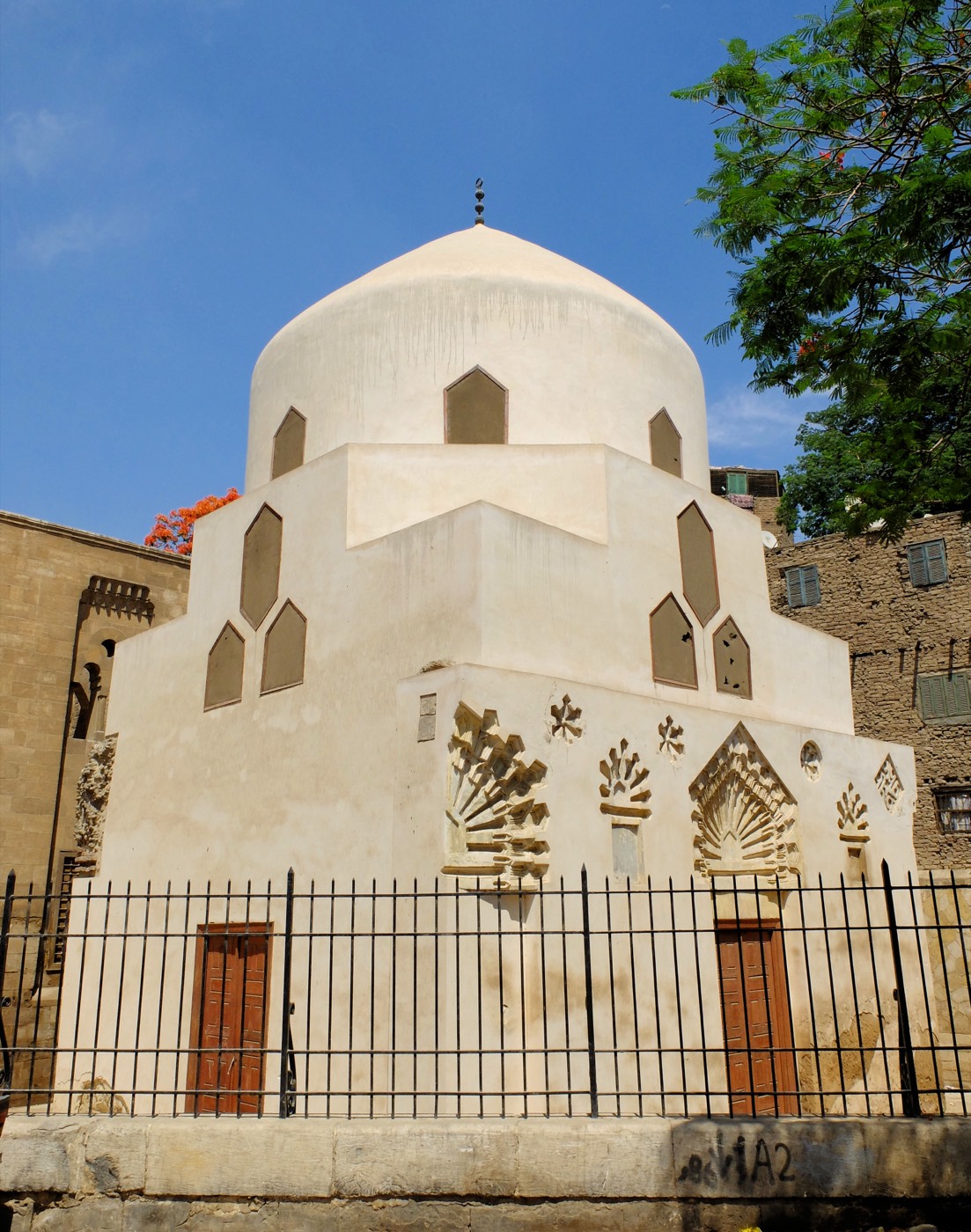
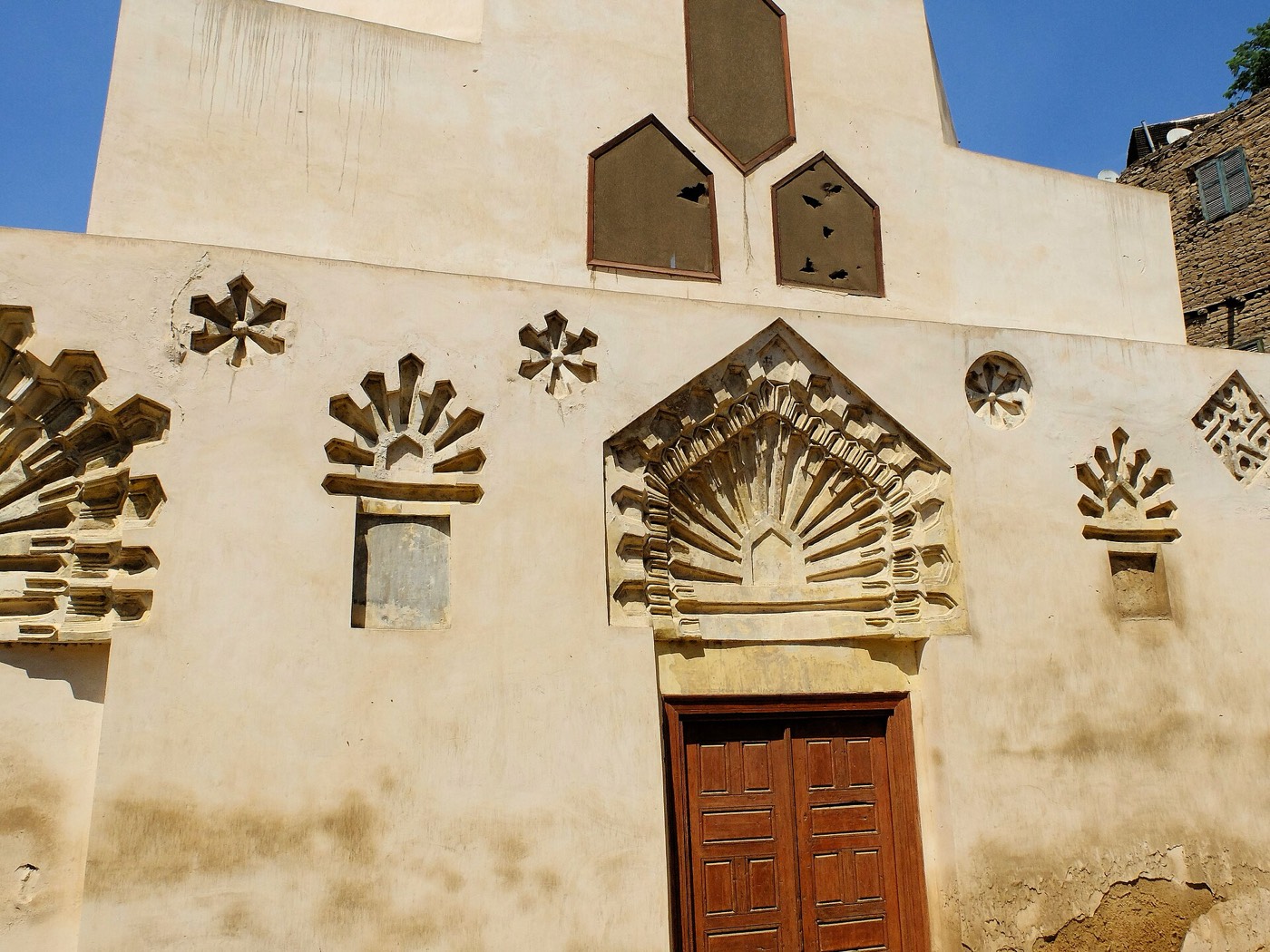
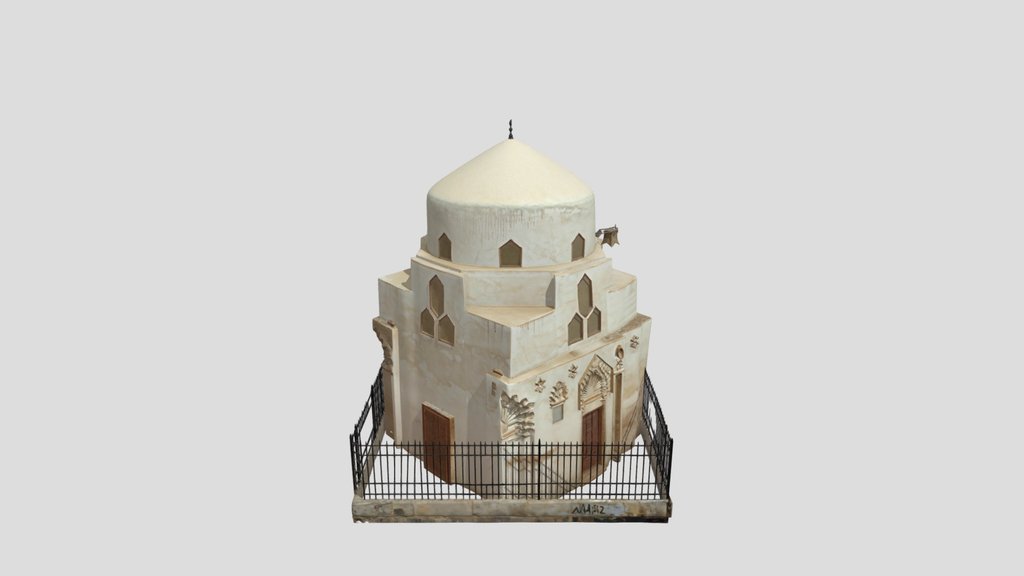
The mausoleum is a square brick chamber with a floor area of about 50 m², covered by a keel-shaped dome2. Eight windows pierce the drum, and the zone of transition below it has two tiers of squinches and windows grouped in threes2. Carved stucco hoods crown the mihrab and the three entrance doors2. ARCE finds its painted interior similar to that of the nearby mausoleum of the Abbasid caliphs (1242)2. Ruggles argues that the gold glass mosaic of the mihrab, a Damascus-style technique often credited in Egypt to the later sultan Qalawun, was introduced by Shajar al-Durr herself8.
An Ottoman-period reference on the dome to an Abbasid caliph, Muhammad al-Khalifa, whom ARCE says cannot be historically authenticated, gave the shrine and then the whole street their name2. A mosque called al-Khalifa, finished beside the dome in 1876, was demolished in the early 20th century, and a second one ordered by Sultan Husayn Kamil (r. 1914-1917) was never completed2. A 2016 American University in Cairo thesis traces the building’s conservation history, focusing on the work of the Comité de Conservation des Monuments de l’Art Arabe12. Works from the 1990s into the early 2000s coated the walls and dome with cement that trapped salty rising damp2. In 2013-2015 a Megawra team led by May al-Ibrashy, funded by ARCE’s Antiquities Endowment Fund and the Barakat Trust, removed the lower cement, desalinated the masonry and uncovered paintings hidden under plaster, probably of the 19th century3,2. The work became the nucleus of a wider programme, Athar Lina (“Heritage is Ours”), that involves the street’s residents in caring for its heritage2.
内部
The inner dome is plain, but between its eight windows are eight painted medallions with tendrils, split palmettes and tulip-like flowers, and triangular soffits carry six-pointed star patterns2. The mihrab holds a glass mosaic of gold and coloured tesserae: a three-branched design that fills the niche, set with rosettes of mother-of-pearl9. ARCE reads the motif as a tree of pearls, a play on her name, and Ruggles calls it “an extraordinary reference to herself in the most highly charged place in any building where prayer occurs”2,8. The mosaic has suffered vandalism; it had been stabilised in an earlier restoration, so the 2013-2015 team left it alone9,2. A painted wooden frieze names Shajar al-Durr as founder, “mother of Khalil” and sultana, and the lamp beam in front of the mihrab bears traces of a naskhi inscription of Quran 7:542.
观赏要点
- The mihrab’s glass mosaic: a three-branched tree with mother-of-pearl rosettes, read as a “tree of pearls”2,9.
- The painted wooden frieze naming Shajar al-Durr as founder, “mother of Khalil” and sultana2.
- Eight painted medallions between the drum windows, uncovered from under later plaster in 2013-20152,3.
- Carved stucco hoods over the mihrab and the three entrance doors2.
- The nearby Abbasid caliphs’ mausoleum of 1242, whose painted interior ARCE compares with this one2.
参观信息
- Only the domed mausoleum survives, on al-Khalifa Street, opposite Fatimid domes conserved as part of the same Athar Lina programme2.
- Among the Fatimid monuments of Historic Cairo, UNESCO names the shrines of Sayyida Ruqayya and ‘Atika, two of the shrines that ARCE lists near the mausoleum1,2.
- ARCE’s article on the conservation says that the authorities had yet to decide how the restored mausoleum would be used2.
官方信息: Egypt’s Ministry of Tourism and Antiquities (Supreme Council of Antiquities)路线在 OpenStreetMap 中打开开罗导览游