这部分尚未翻译,暂以英文显示。
历史
The tomb stands near Gulustan village in Julfa district, Nakhchivan, in a reserve on the left bank of the Araz, about 30 km from Nakhchivan city1,3. It has no documented date, and its builder and occupant are unknown3. Azerbaijan’s 1998 UNESCO Tentative List entry dates it to the 12th century5. The Presidential Library of Azerbaijan and a Soviet art encyclopedia of 1986 date it to the early 13th century, the Library seeing in it the influence of the Momine Khatun tomb of 11861,2,3,4. Shchetnikov places it in the second half of the 12th century, before the Mongol invasion, and attributes it to Ajami ibn Abi Bakr or someone from his school3.
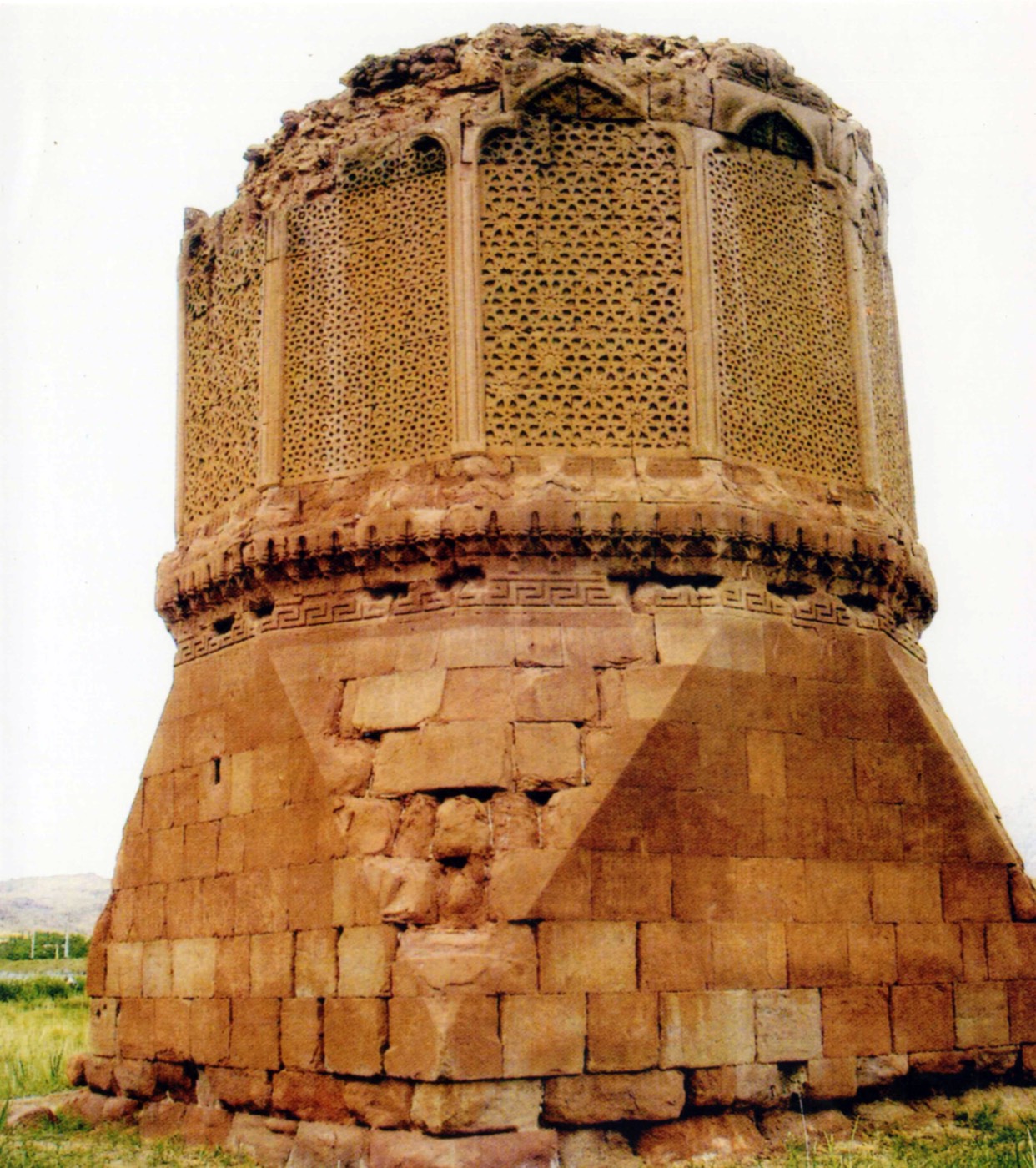
Medieval sources call the tomb Kəsik günbəz1. The Presidential Library treats it and the remains around it as one archaeological complex, and the Gulustan Historical-Cultural Reserve was set up to protect the area1. In 1998 Azerbaijan included the tomb, with the other Nakhchivan mausoleums, on its UNESCO Tentative List1,5. Its tent roof was completely destroyed: the Tentative List entry calls it pyramidal, while the Library finds its original shape, pyramidal or conical, hard to establish2,5. On 7 October 2015 the chairman of the Supreme Assembly of the Nakhchivan Autonomous Republic ordered the tomb’s restoration and study1. Writing in 2026, Shchetnikov describes the tower with a restored pyramidal roof3.
建筑
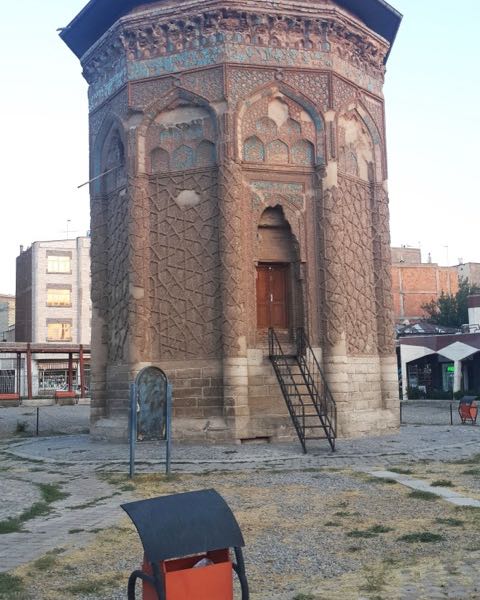
The base, of dressed stone, is square in plan (6.6 × 6.6 m) at ground level and narrows as a truncated pyramid to a regular twelve-sided top; inside it is cylindrical1,2,5. Unlike other tombs in Azerbaijan, whose crypts lie underground, this one has its crypt inside the raised base2. On the base stands a twelve-sided upper chamber of red sandstone1,2,5. Carved bands of muqarnas (“stalactite” work) mark the junction of the body and the base and the start of the roof2.
Each of the twelve faces has an arched frame around a recess filled with finely carved geometric ornament, and the designs are placed so that neighbouring faces differ: only three patterns repeat in turn around the tower1,2,3. Shchetnikov identifies them as ten-petal rosettes framed by five-pointed stars, eight-petal rosettes with octagons, and twelve-petal rosettes with hexagons and an octagon3. The eight-petal pattern appears, turned through 45 degrees, on the entrance side of the Momine Khatun tomb, and the twelve-petal rosettes recur there too3. The Presidential Library compares the tomb with the stone tombs of Seljuk Anatolia and relates its ornament to the work of Ajami’s school1,2.
观赏要点
- Three carved geometric patterns repeated in turn around the twelve faces1,2,3.
- The crypt set inside the raised stone base, not underground2.
- A base that turns from a square at the ground into a twelve-sided top1,2,5.
- Carved muqarnas bands where the body meets the base and the roof2.
- The eight-petal rosette pattern also used on the Momine Khatun tomb3.
参观信息
- The tomb is in the Gulustan Historical-Cultural Reserve on the left bank of the Araz, near Gulustan village1.
- The present roof is a reconstruction: the original was destroyed before the restoration ordered in 20151,2,3.
- Nakhchivan city, with Ajami’s tombs of Yusif ibn Kuseyir and Momine Khatun, lies about 30 km away3.