这部分尚未翻译,暂以英文显示。
历史
Nader Shah, born in 1688 north of Mashhad and shah of Iran from 1736, made Mashhad his capital2,4. In 1732-33, while still governor of Khorasan, he built himself a tomb in the Bala-Khiaban quarter; no plan survives, but its endowment deed, kept at the Astan Quds Razavi library, points to a luxurious building in a garden2. In 1738-39 he invaded India and took Delhi2,4. He was killed by his own officers in June 1747 and buried in Mashhad, in the tomb he had built for himself and his son Reza Qoli Mirza1,2,4. Agha Mohammad Khan Qajar later had the tomb razed and the bones placed under the threshold of his palace in Tehran1.
In 1917-18 the governor of Khorasan, Ahmad Qavam, had the bones brought back from Tehran and a brick tomb built over them, but damp later ruined it1,3. After the coup of August 1953 the Society for National Heritage took up the Shah’s order for a worthy tomb, and in May 1955 it set up a commission, which chose Houshang Seyhoun for the building and Abolhassan Sadighi for the statue1. The technical council of Tehran University’s Faculty of Fine Arts and then the Shah approved their designs1. Work began in late 1956 under the supervision of Mohsen Foroughi and Hossein Joudat and ended in 1961-62, and the Shah inaugurated the complex on 1 April 19631.
建筑
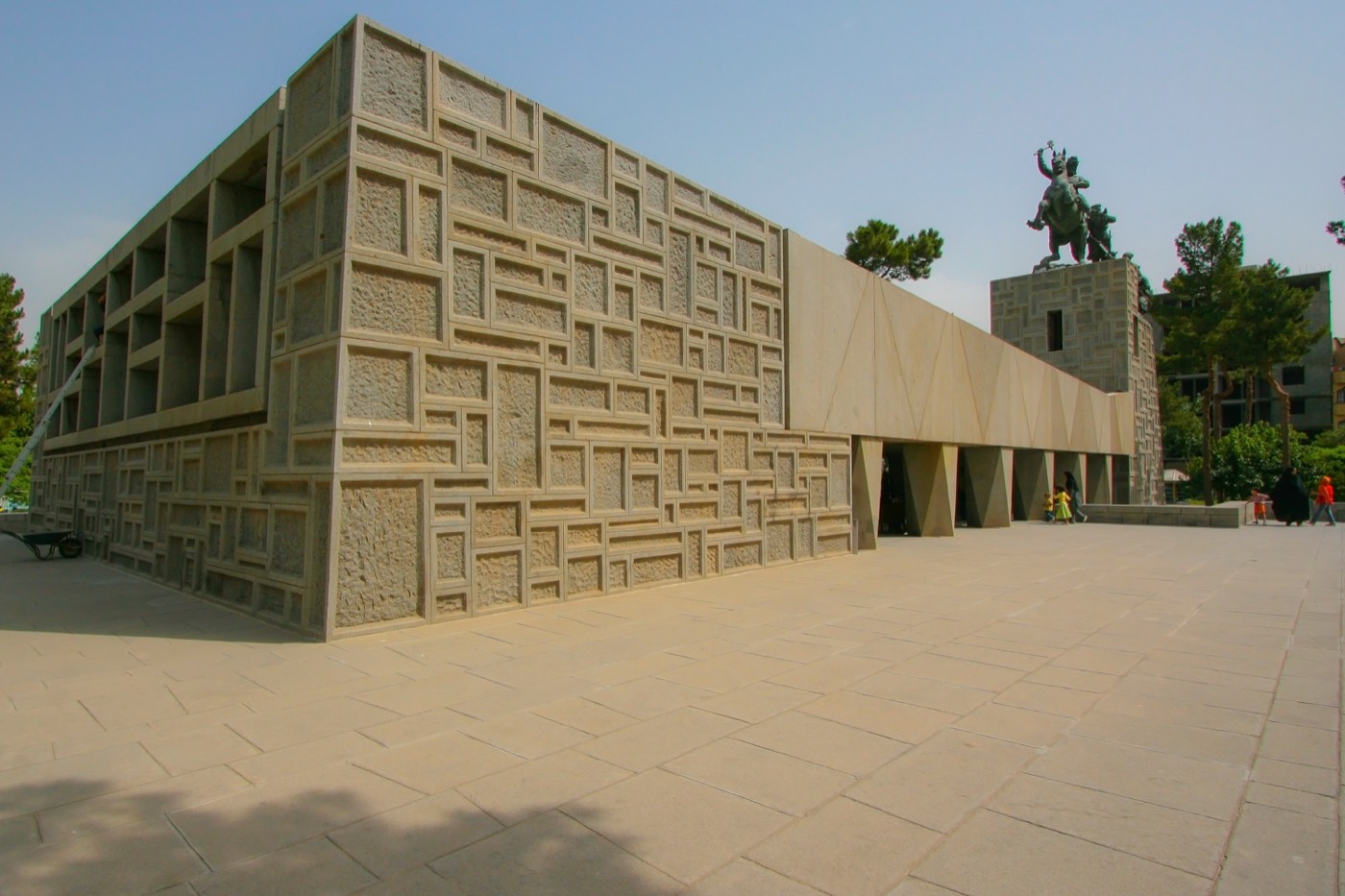
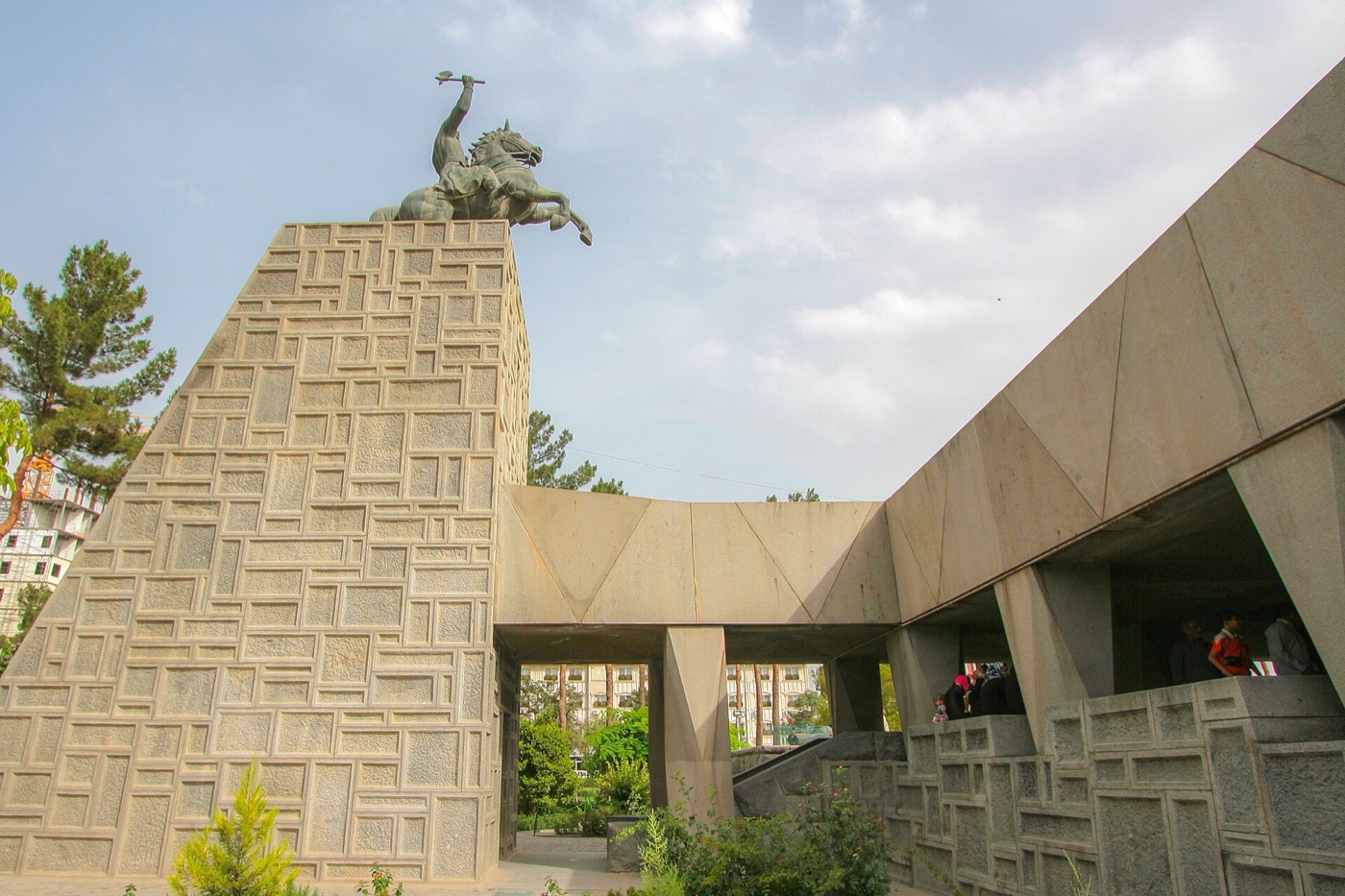
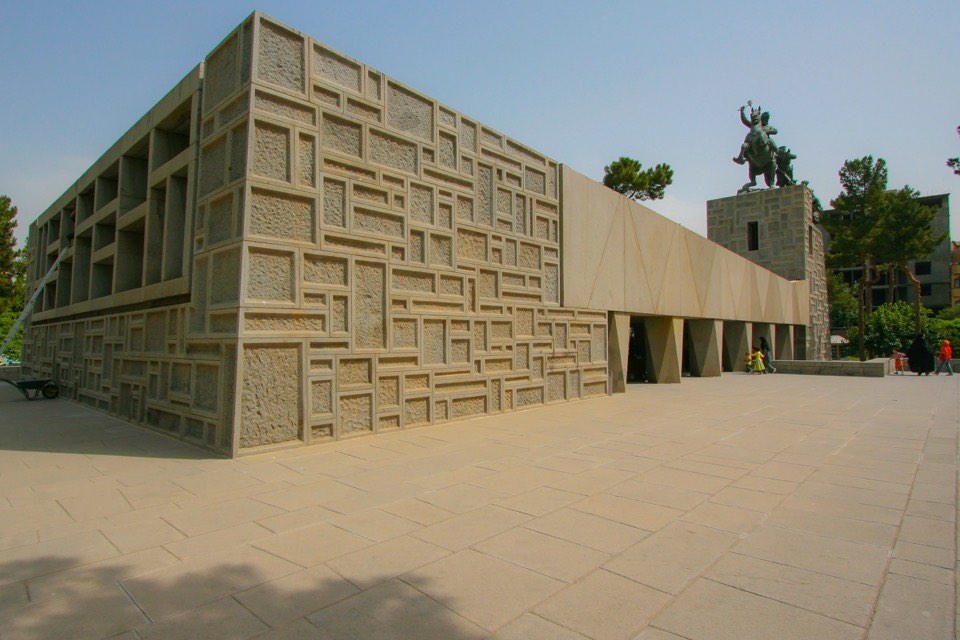
Seyhoun based the design on two shapes, the square and the triangle, and built it of large blocks of granite, described as a sign of Nader’s ‘firmness and greatness’1; Visit Iran says the stone came from the mountains around Mashhad3. Because the soil was weak, the tomb and the statue rest on a thick raft of reinforced concrete1. The complex groups a tomb hall with two museum halls, one for weapons of Nader’s time and one for earlier weapons, and a tall tower designed together with the statue group so that Nader seems to surge from the tower towards the museum1. According to Esmaili and his co-authors, the design drew on the Tarikhaneh mosque at Damghan1.
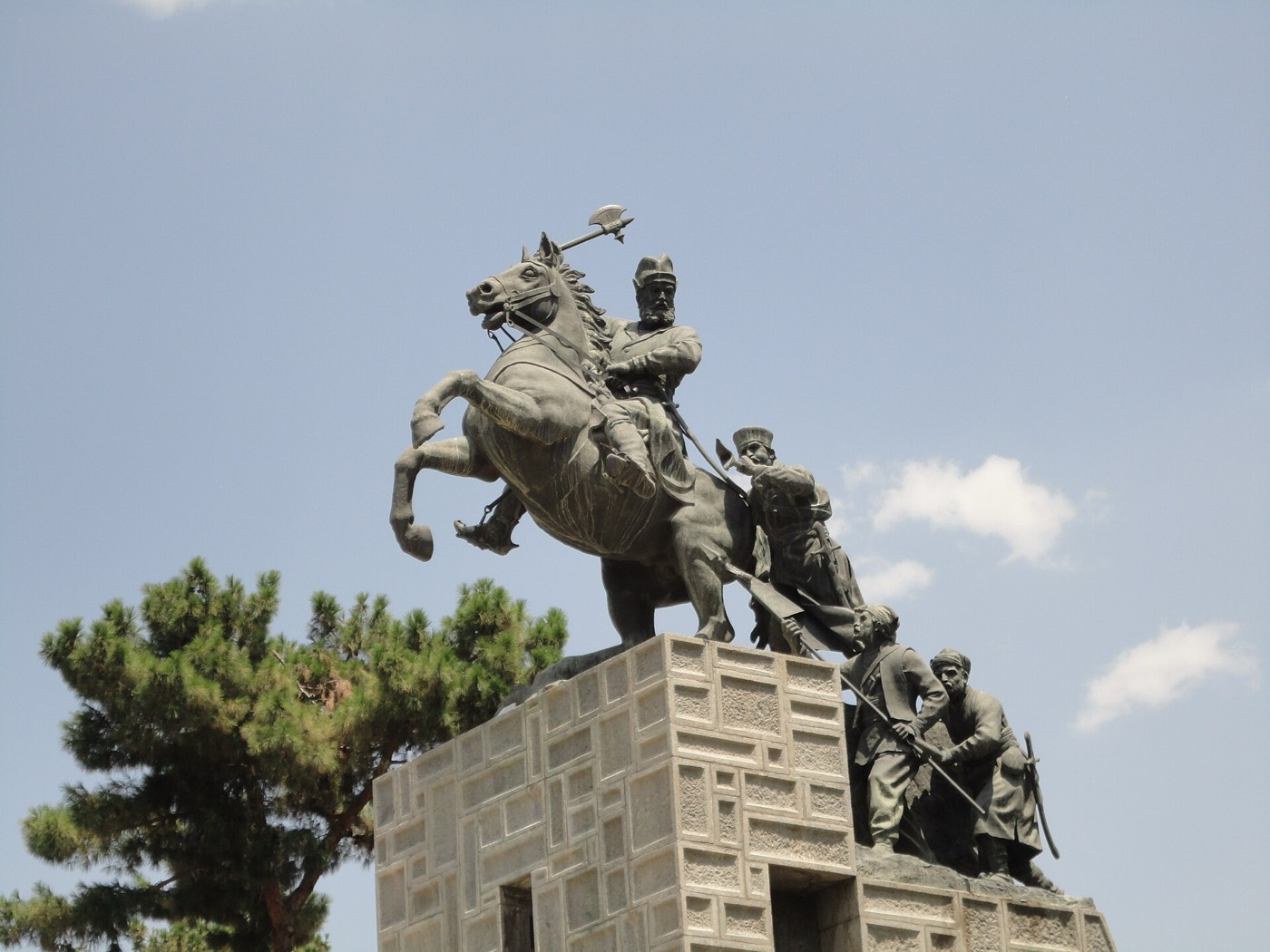
The bronze group, 6.5 m high, shows Nader on a rearing horse, followed on foot by a trumpeter, a flag-bearer and a musketeer, with two large panels in half relief1. Sadighi made the model, the Bruni foundry in Rome cast it, and it was shipped from Livorno and set on its tall granite base on 8 November 19601. Visit Iran describes three linked porches on the east, south and west sides of the main building, and a garden laid out on the pattern of the Persian garden, enclosed by a granite wall and iron railings with a battle-axe motif3.
内部
The tomb hall is square: two walls of red stone close it on two sides, and two open colonnades form the other two1. Nader’s gravestone lies in the corner sheltered by the walls; Seyhoun wrote that this corner and the open sides evoke attack and defence, the red colour war, and the stone projections on the walls Nader’s battles1. Each column has a square base and a square top turned 45 degrees to each other, producing eight triangular faces that recall Nader’s hat1. The roof recalls the nomad’s tent in which Nader was born and killed, and Visit Iran says the gravestone was carved on the model of the Darya-ye Nur diamond that Nader brought back from India1,3.
观赏要点
- Sadighi’s 6.5-metre bronze group of Nader on a rearing horse with three soldiers, cast in Rome1.
- The gravestone in the corner between two red stone walls, with the hall open on its other two sides1.
- Columns whose base and top squares are turned 45 degrees, forming eight triangles that recall Nader’s hat1.
- The granite tower carrying the statue group, designed with it as a single composition1.
- Museum halls with Afsharid weapons, uniforms, paintings, manuscripts and two swords of Nader3.
参观信息
- The tomb stands in the Naderi Garden in the centre of Mashhad3.
- The museum has two halls: one for Afsharid objects and weapons, and one, added in 1994-95, for pictures, coins and objects from the Safavid period to modern times3.
- The grave of Mohammad Taqi Khan Pesyan, a military commander in Khorasan in the late Qajar period, also designed by Seyhoun, lies in the northern corner of the complex3.
官方信息: Iran’s Ministry of Cultural Heritage, Tourism and Handicrafts (Visit Iran says the complex is run by the cultural heritage organisation)路线在 OpenStreetMap 中打开马什哈德导览游