这部分尚未翻译,暂以英文显示。
历史
Sinan was taken into Ottoman service through the devşirme levy in the reign of Selim I, from the province of Kayseri, and TDV considers his origin in the village of Ağırnas to be documented2. He fought in Süleyman I's campaigns from Belgrade (1521) and Rhodes (1522) onwards, and in 1538, at about 48, he built a bridge over the Prut in thirteen days; he was then made chief architect of the court2. The ministry says he held the post for 49 years4. Sinan summed up his career in three mosques, calling the Şehzade Mosque (1548) his apprentice work and the Süleymaniye his journeyman's work; TDV notes that the Selimiye in Edirne is counted as his greatest2.
He made the pilgrimage to Mecca in 1584 and kept working until his death in 996 AH (1588), when TDV puts his age at about a hundred2. He was buried at the Süleymaniye, the complex he built for Süleyman I in 1550-1557, which UNESCO calls one of the “unique architectural masterpieces” of the Byzantine and Ottoman periods1,2,3. Sinan chose the site himself, and his house stood between the tomb and the Third (Sâlis) Madrasa5,6. Sezer writes that he built the tomb and a public fountain there; Öter finds no record that he built the tomb but concludes that he must have done so5,6. TDV knows of no other complex that holds its architect's tomb besides those of its founder and his wife3.
建筑
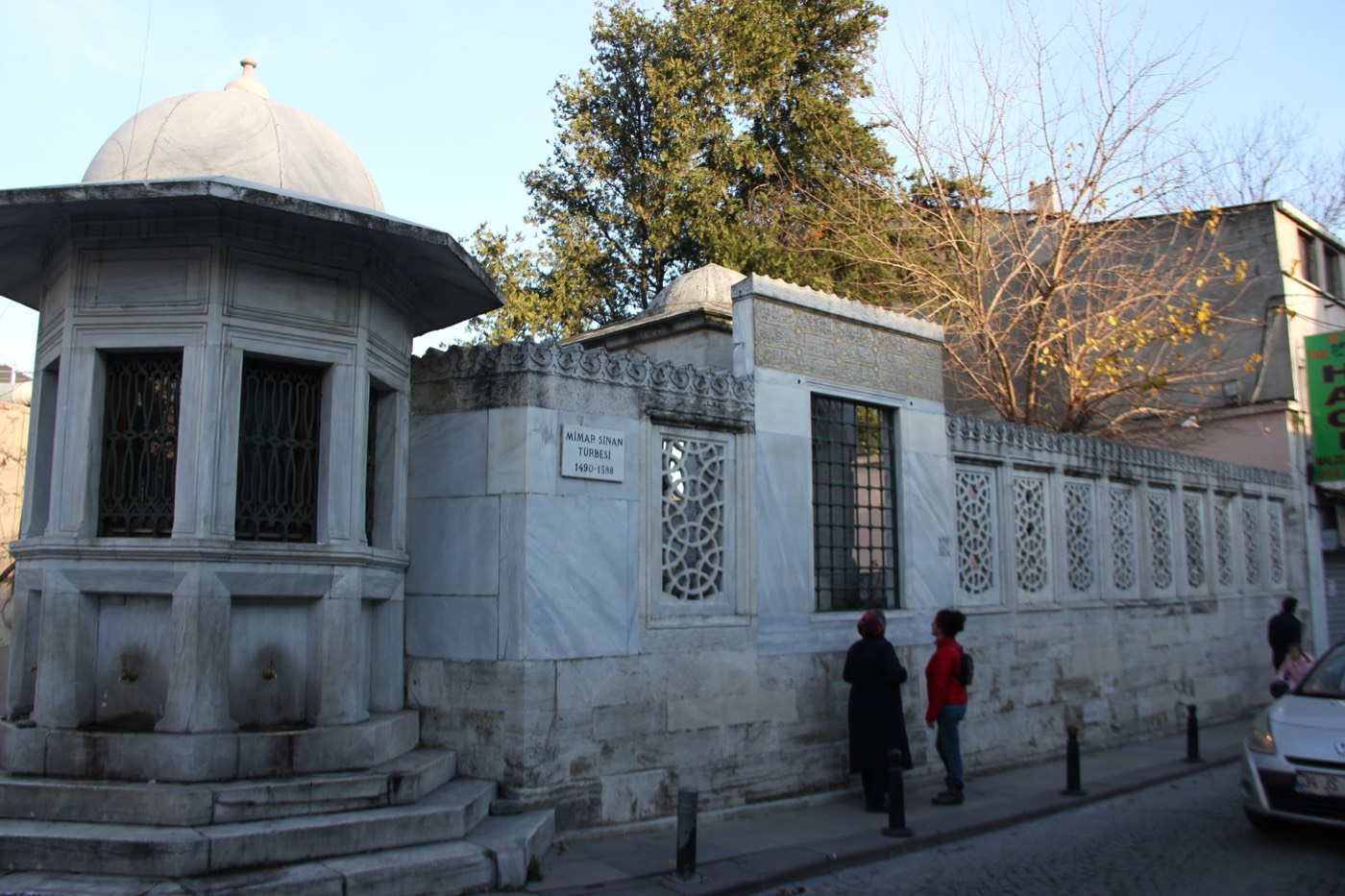
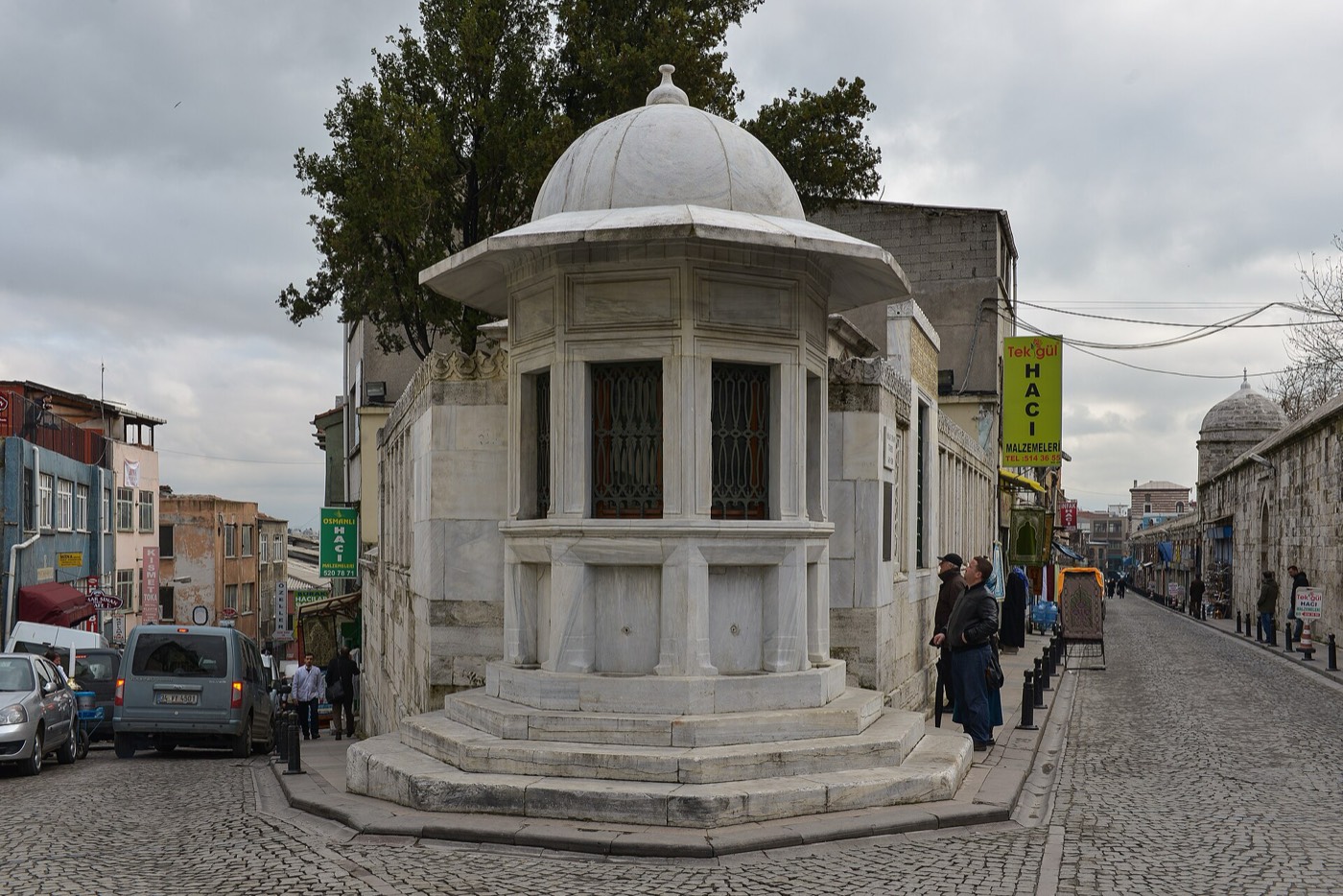
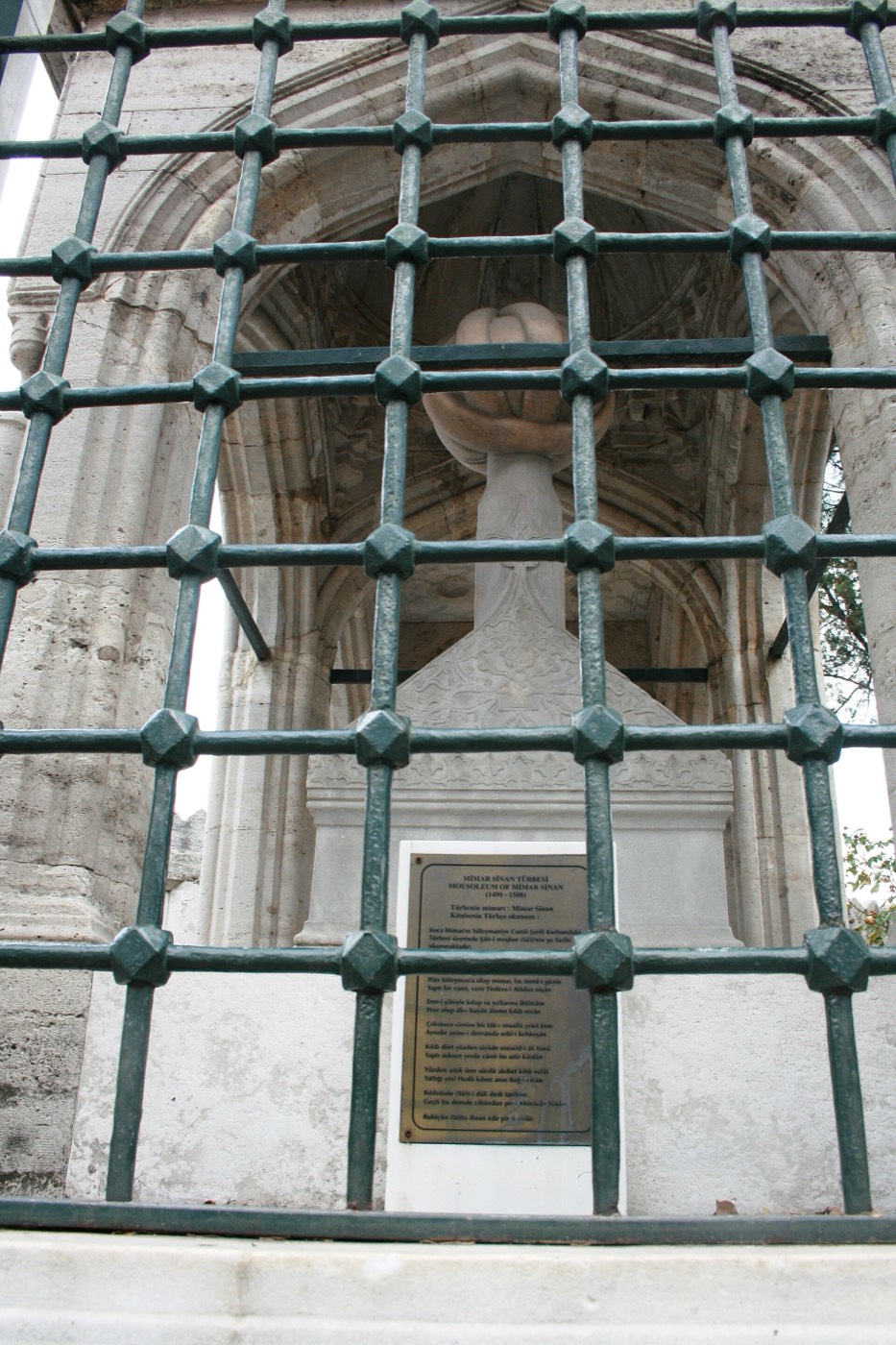
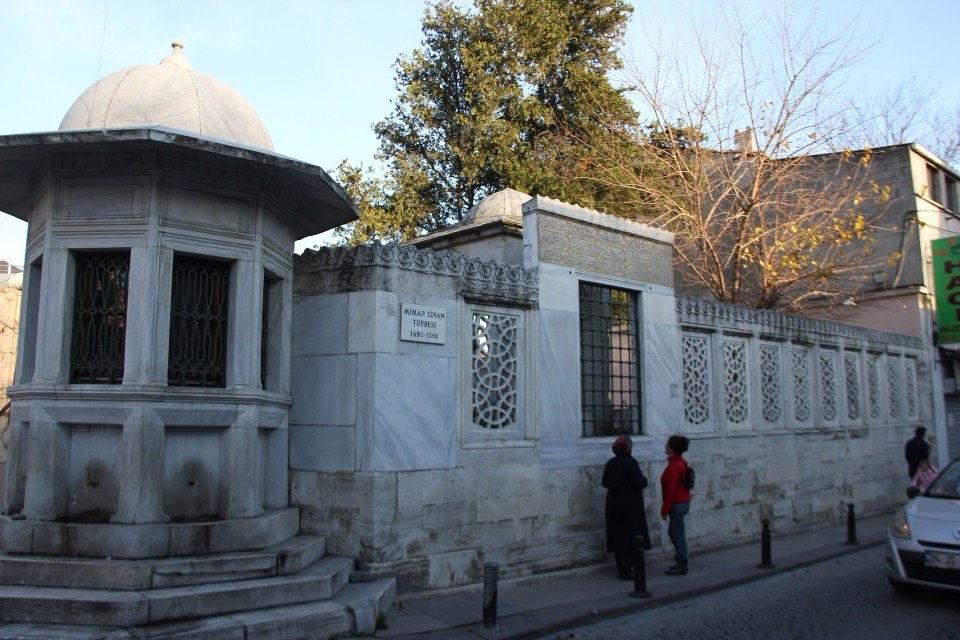
The tomb lies in a small burial plot north of the mosque, west of the arasta (row of shops) and the Third (Sâlis) Madrasa3. A domed sebil, or public drinking fountain, stands at the corner of a small triangular plot between two streets, and the tomb is set just behind it3,5. TDV describes the tomb as a garden pavilion over a rectangle sized for the stone sarcophagus, open through one arch on the short side and two on the long side; the arches rest on masonry piers and the roof slopes on four sides, a form known from early Ottoman tombs3. The ministry describes it instead as an open tomb of köfeki stone and marble covered by a dome on six columns joined by pointed arches4. Öter, in a study of the building, describes six fluted piers and pointed arches under a hipped roof, with a flat ceiling and, over the head of the sarcophagus, a small dome that rises slightly above the roof6. Sâî's verse inscription, in gilt letters on white marble, is set in the enclosure wall facing the mosque, above a grilled window3,6.
内部
Beneath the canopy lies Sinan's marble sarcophagus, 2.70 m long and made of three blocks, with a headstone that ends in a carved turban3,6. The ministry notes a single block of marble in front of it carrying an inscription in thuluth script by Sâî, and three other graves in the plot: one of the architect Ali Talat Bey and two unidentified4. TDV quotes the last line of Sâî's epitaph: “Geçti bu demde cihandan pîr-i mi‘mârân Sinân” (“In this moment Sinan, the elder of architects, passed from the world”)2,3.
观赏要点
- Sâî Mustafa Çelebi's verse epitaph, ending with the line on Sinan, “the elder of architects”2,3.
- The domed sebil at the street corner in front of the tomb3,5.
- The small open canopy, a form TDV relates to early Ottoman tombs, with a little dome over the sarcophagus3,6.
- The Süleymaniye complex around it, which Sinan built in 1550-15571,3.
参观信息
- The tomb is on the street north of the Süleymaniye Mosque, west of the Third (Sâlis) Madrasa3.
- It is one of the tombs assigned to the ministry's Istanbul Tombs Museum Directorate4.
- Süleyman I's own tomb stands in the walled cemetery behind the mosque's qibla wall3.
官方信息: Istanbul Tombs Museum Directorate (İstanbul Türbeler Müze Müdürlüğü), Republic of Türkiye Ministry of Culture and Tourism路线在 OpenStreetMap 中打开伊斯坦布尔导览游