这部分尚未翻译,暂以英文显示。
历史
Hafez, whom Britannica calls one of the finest lyric poets of Persia, was born in Shiraz in the early fourteenth century and died there in 1389 or 13902,3. He was buried in the Musalla garden on the northern edge of the city, the ‘Golgasht-e Mosalla’ often mentioned in his poems1. In 1452 the Timurid governor of Fars, Abu’l-Qasem Babor, had a domed structure raised over the grave1. In 1187 AH (1773-74) Karim Khan Zand enlarged and enclosed the site, adding a four-columned hall and a marble gravestone carved in nastaliq script with two of Hafez’s ghazals1. The tomb was restored again in 1857, and a wooden enclosure was built around it in 18781.
In 1935 the Fars Department of Education, on the initiative of the Minister of Education Ali-Asghar Hekmat, arranged for a new building, and the French archaeologist André Godard, technical director of Iran’s Department of Antiquities, drew up the design1. The work was entrusted to Ali Riazi, head of education in Fars, with Ali Sami as supervisor1. According to a 2024 study, construction began in 1938 and was completed in 19404. Archnet and Encyclopaedia Iranica’s article on Godard also credit the architect Maxime Siroux, but the same study argues that Godard was the designer, as Ali Sami confirmed in his own book4,5,6.
建筑
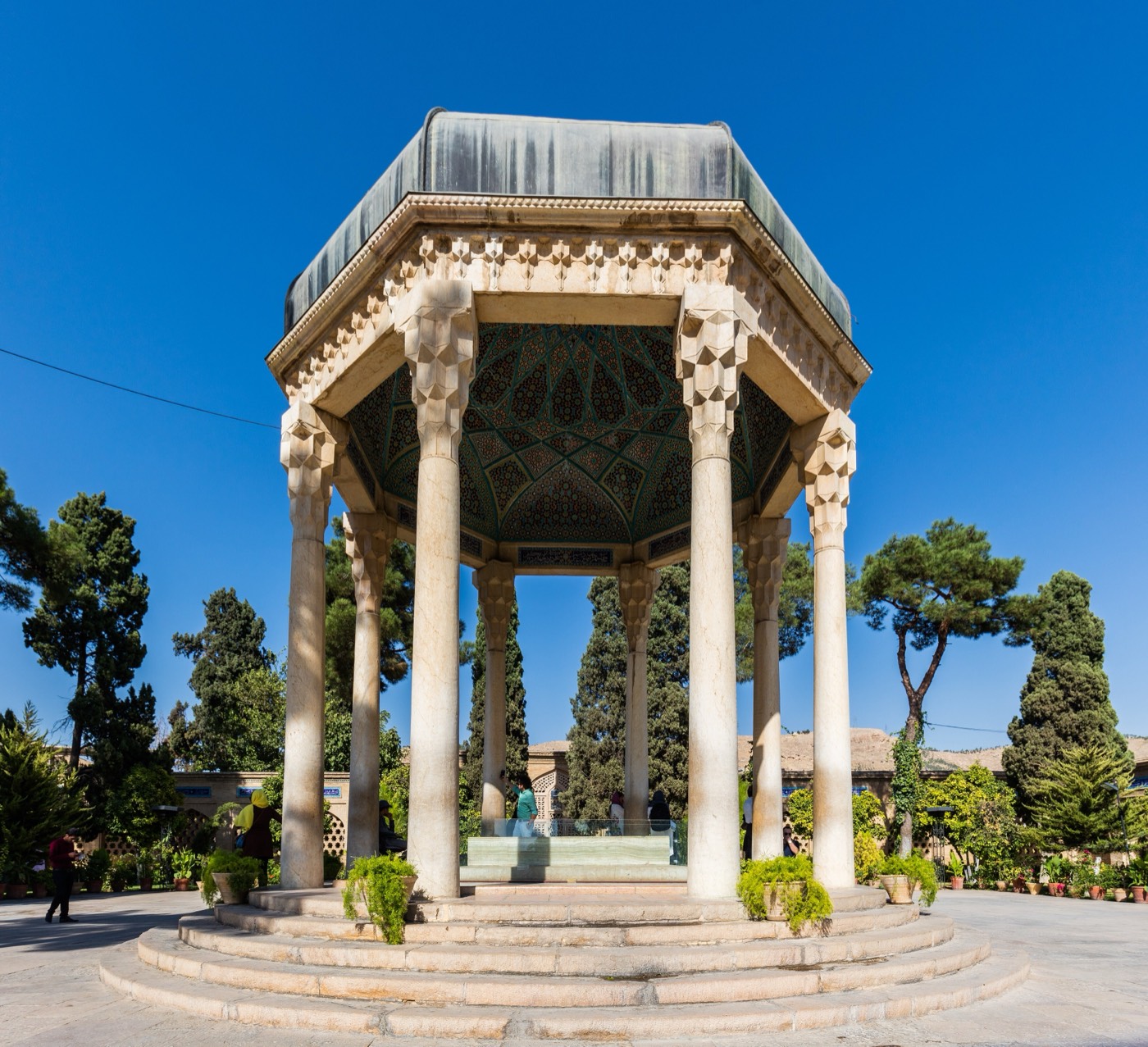
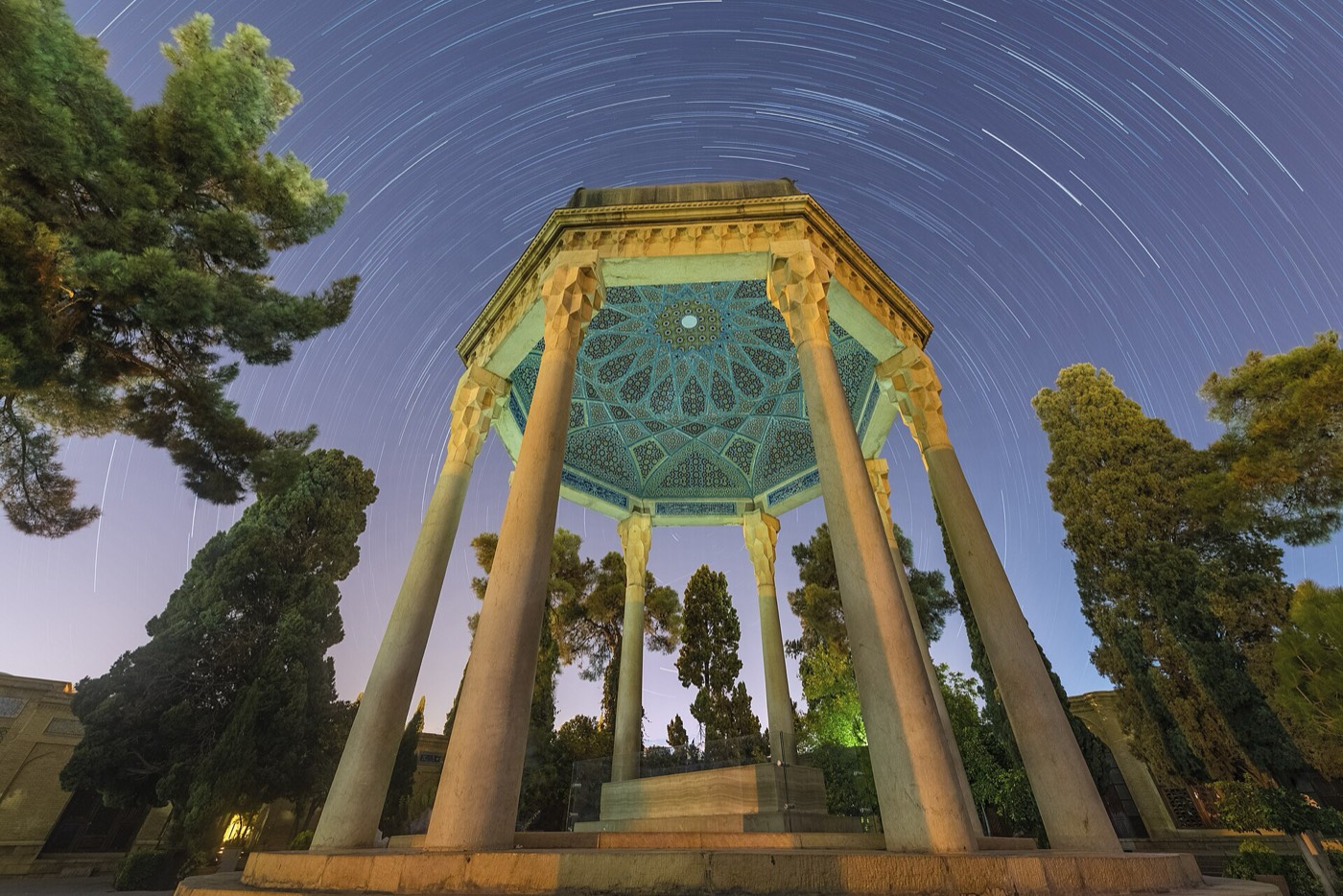
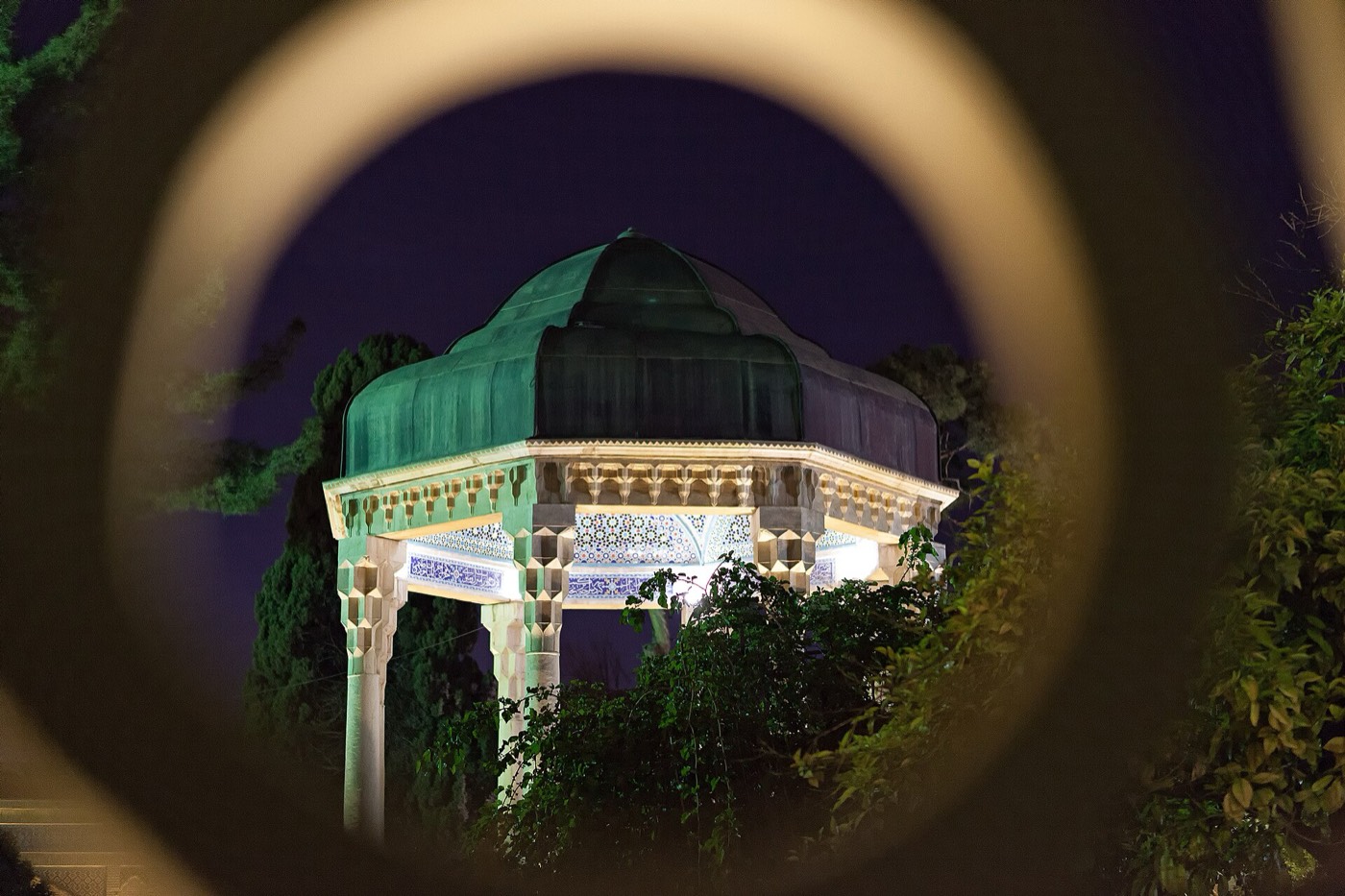
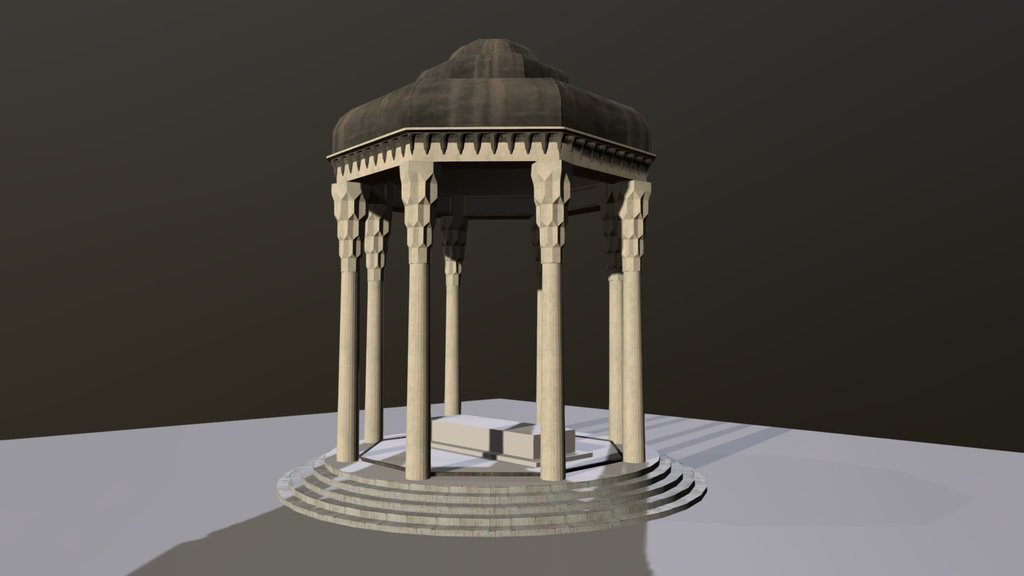
Godard kept Karim Khan’s four-columned hall and made it the core of a longer columned hall (talar) with sixteen matching stone columns added, about 56 by 7 metres, which divides the complex into a southern entrance garden with orange trees and pools and a northern garden around the tomb1,4,5. The grave itself, raised one metre and ringed by five circular steps, lies under an open pavilion: eight stone columns about ten metres high, with muqarnas capitals like those of Zand buildings in Shiraz, carry an octagonal frieze and a copper dome shaped like a dervish’s hat1,5.
Inside the pavilion, tile inscriptions of Hafez’s verses run around the octagonal frieze, and the underside of the dome is worked in the Iranian net-vault technique known as karbandi or rasmi-bandi4,5. The marble slab placed on the grave in Karim Khan’s time is still there1. Verses also appear in tiles on the talar, stone fountains taken from Zand buildings in Shiraz were set in the garden pools, and an older tomb building north of the grave was turned into a library1,4.
观赏要点
- The Zand-era marble gravestone, carved in nastaliq script with two of Hafez’s ghazals1.
- The dervish-hat dome on eight stone columns with Zand-style muqarnas capitals1,5.
- Hafez’s verses in tilework around the inner octagonal frieze5.
- The 56-metre columned hall that incorporates Karim Khan Zand’s original four-column hall1,4,5.
- Stone fountains from Zand buildings reused in the garden pools4.