这部分尚未翻译,暂以英文显示。
历史
Mehmed I (Çelebi Mehmed), a son of Bayezid I, ruled from 1413 to 1421 and restored Ottoman power after Timur's victory over his father at Ankara in 14024,5. In Bursa he founded the complex later named Yeşil (Green) after the tiles of its mosque, tomb and madrasa; TDV lists a mosque, madrasa, public kitchen (imaret), tomb and khans4. The mosque was begun in 1414 and finished in December 14194. According to TDV, craftsmen from Tabriz, brought back by Ottoman scholars and artists returning after Timur's death in 1405, helped plan the mosque and made its tiles4. ICOMOS notes that the complex is said to symbolise the rebirth of Ottoman rule after the defeat of 14023.
Mehmed I died at Edirne in 1421 and was buried in this tomb, which TDV dates to the same year5,6. Bursa's monument inventory in the UNESCO nomination says that Hacı İvaz Pasha built it on Mehmed I's order, while Archnet names his son and successor Murad II as patron2,7. Kültür Portalı adds that it was finished forty days before the sultan's death6. The 1855 earthquake damaged the entrance, which was repaired in 1864, and Archnet says the outer tiles are replacements for those lost in that earthquake6,7. Osman Hamdi Bey painted the interior in 'Prayer in the Green Tomb' (1882)2. After a full restoration the tomb reopened to visitors in 20094.
建筑
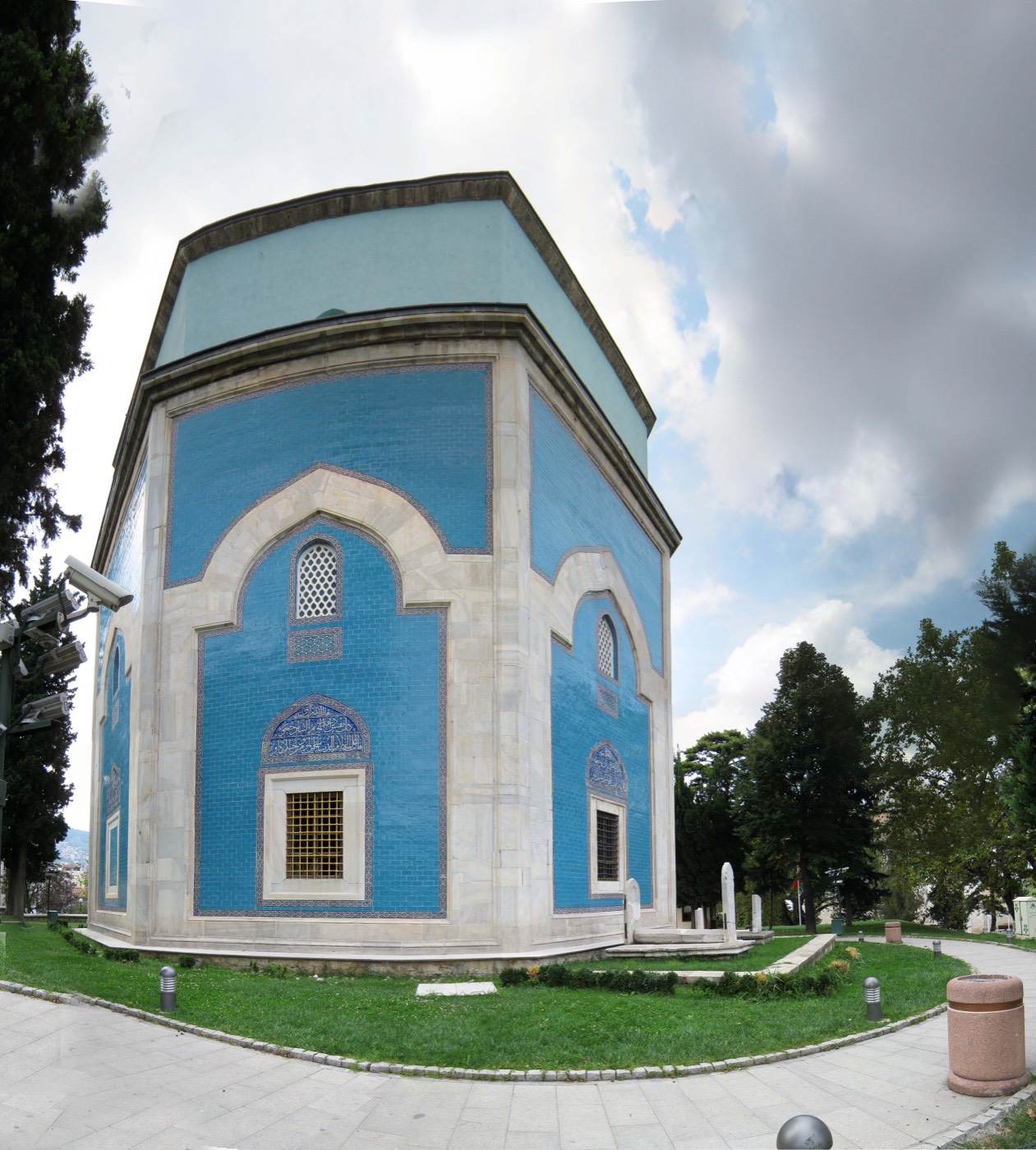
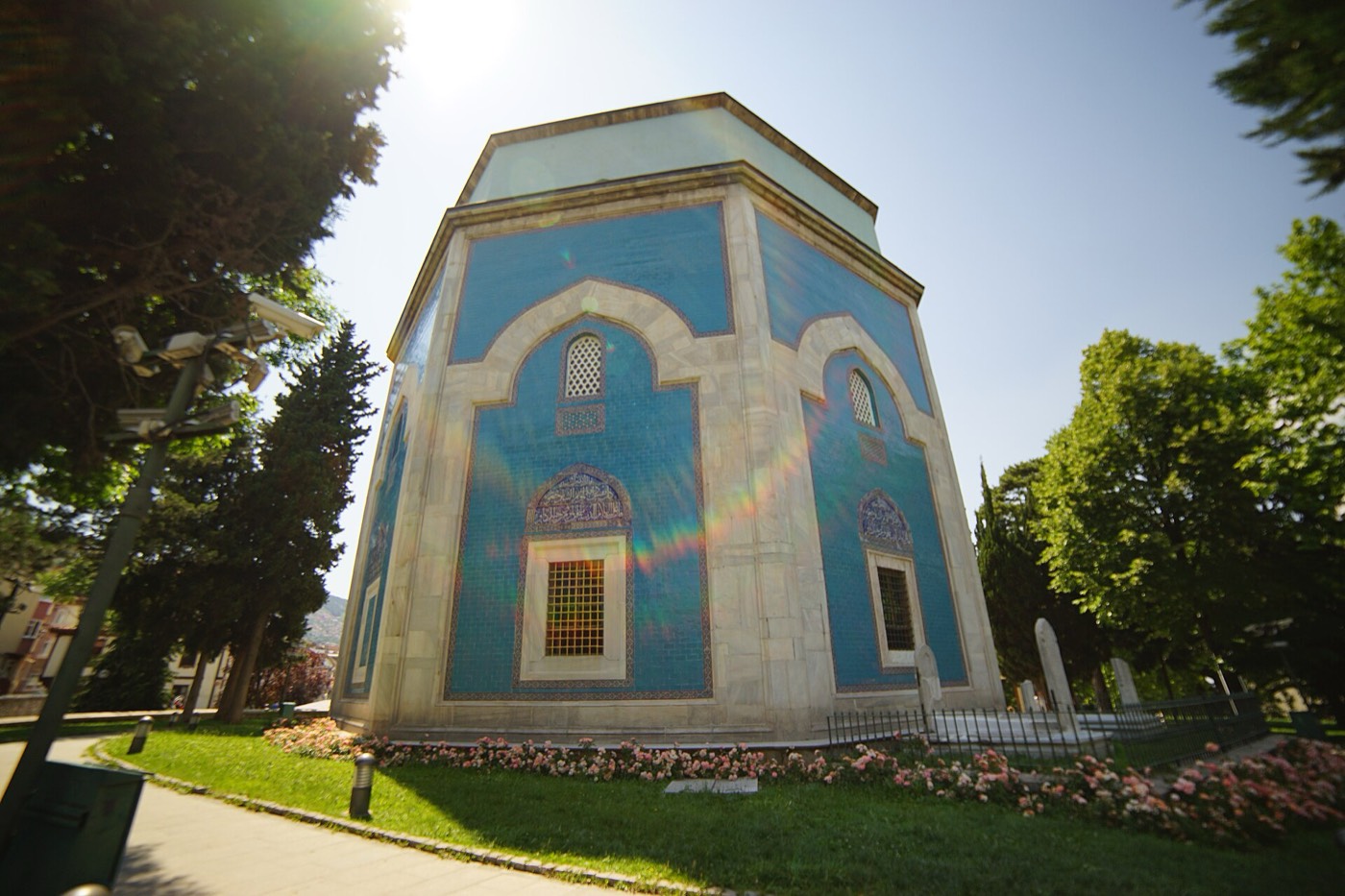
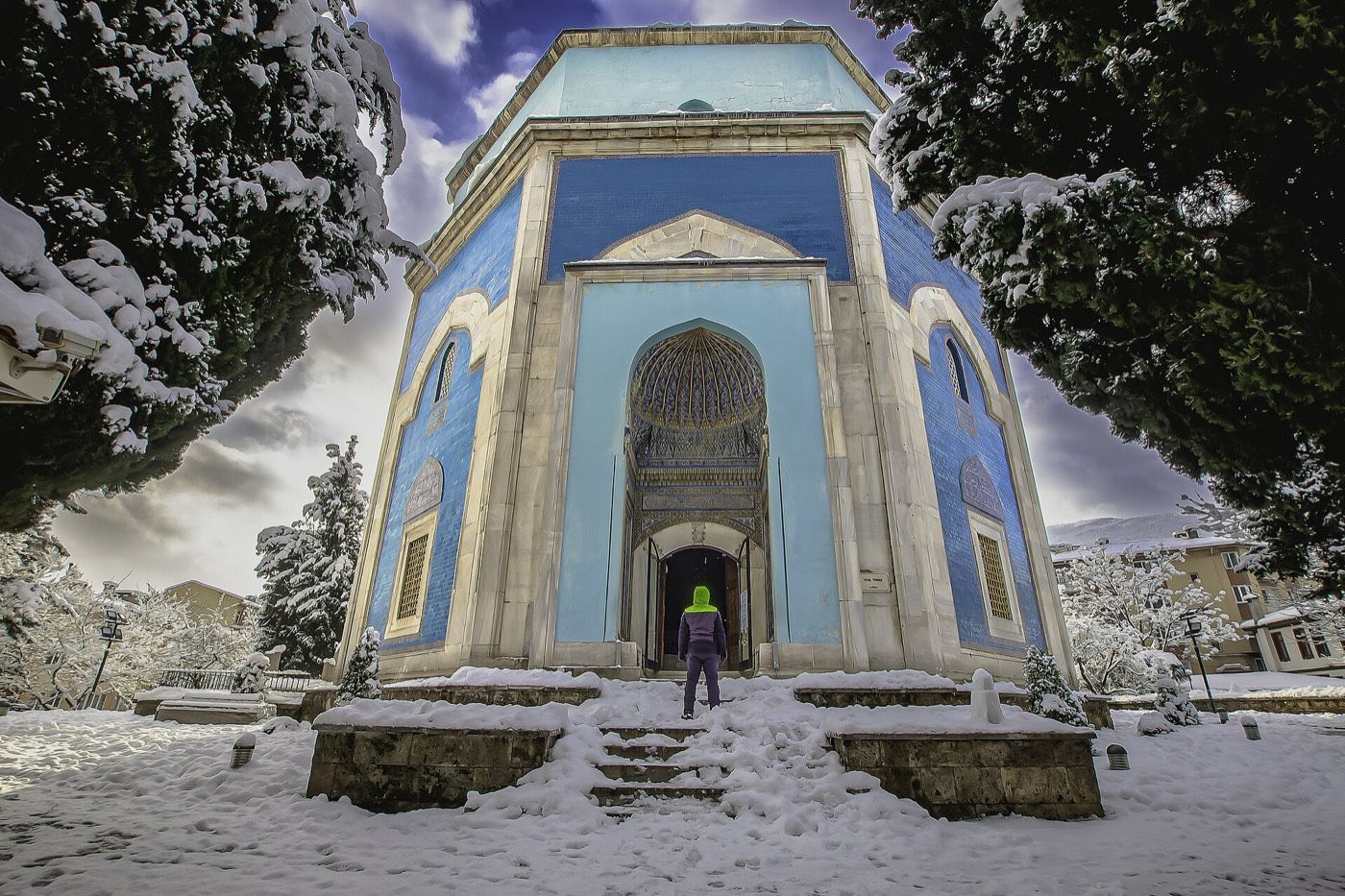
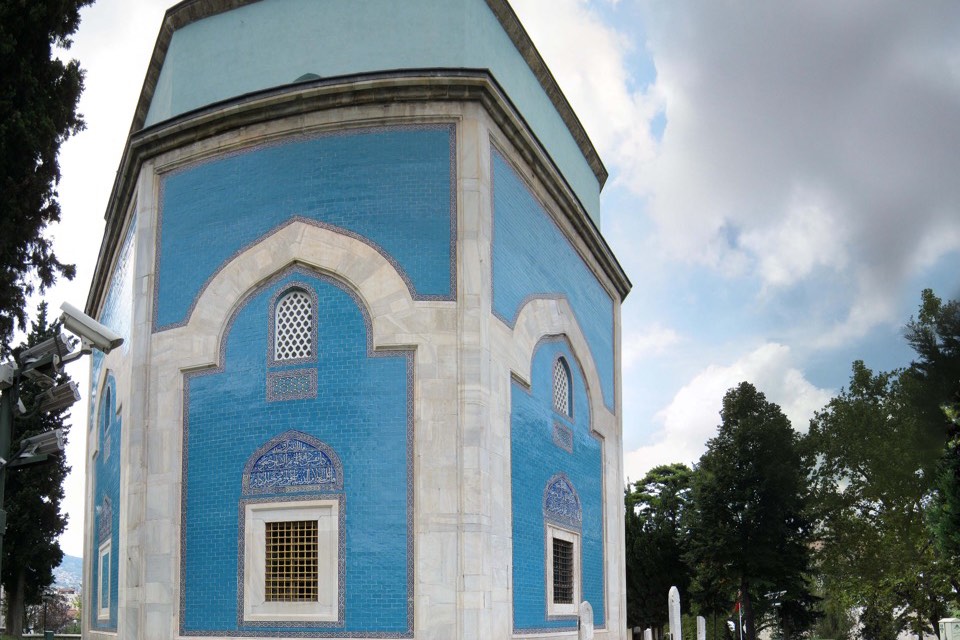
The tomb stands on a small hill directly opposite the Yeşil Mosque4. It is an octagon on a base of küfeki stone, and its high drum and its dome, set on 'Turkish triangles', raise it to 25.5 m; TDV calls it the tallest of Ottoman tombs4. The nomination file gives a ground area of 328 m² and describes the dome as pointed2. Each face is framed in white marble and carries a pointed blind arch; except on the north and south faces it holds a large rectangular window below and a pointed window with a plaster grille above6. Tile borders outline the frames and windows, turquoise tiles face the other surfaces, and the window lunettes carry Qur'anic verses and hadiths on a dark blue ground2,6.
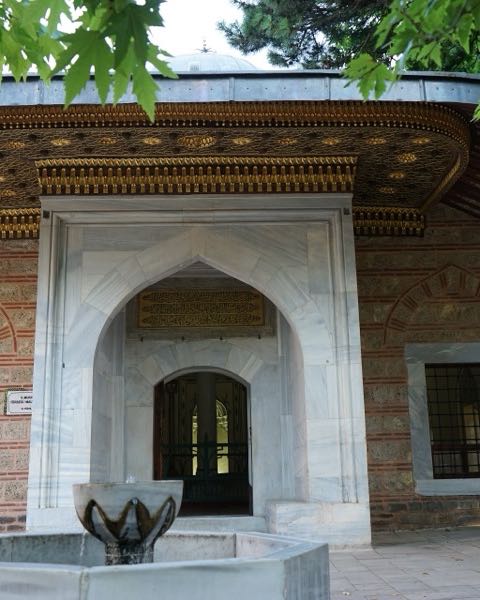
The entrance portal, re-plastered with horasan mortar in 1864, frames a carved wooden door of the kündekâri type2,6. The door bears the names of Mehmed I and Hacı İvaz Pasha and the signature 'Amel-i Hacı Ali b. Ahmed-i Tebrizi', naming the master of the complex's woodwork4. The nomination file names Ali bin İlyas Ali, Mehmed el-Mecnun and Ali bin Hacı Ahmed of Tabriz as the decorators of the tomb2. Patricia Blessing argues that the tilework of the mosque and tomb engages both with the Seljuk architecture of Anatolia and with the Persianate culture of post-Mongol Iran and Central Asia8.
内部
Inside, hexagonal turquoise tiles framed by two borders line the walls to a height of about 3 m2. The lunettes of the windows carry hadiths, and large sunburst medallions (şemse) with pendants fill the spaces between the windows4. On the qibla wall the tile mihrab has a muqarnas hood set in a wide frame of tilework, and the mosaic inside its niche shows roses, carnations and hyacinths7. In the centre stands Mehmed I's cenotaph, covered entirely in relief tiles in yellow, dark blue and white, which TDV describes as without parallel4,7. Around it are the cenotaphs of his sons Mahmud and Yusuf, his daughters Selçuk Hatun, Hafsa, Ayşe and Sitti Hatun, and their nurse6,7. These only mark the graves: the burials lie in a barrel-vaulted crypt below, divided into five sections according to the nomination file2,4. Archnet notes that the chandelier and the coloured glass windows are later additions7.
观赏要点
- The tile mihrab, its niche filled with a mosaic of roses, carnations and hyacinths7.
- Mehmed I's cenotaph, covered entirely in relief tiles of yellow, dark blue and white4.
- The carved wooden door naming Mehmed I, Hacı İvaz Pasha and the woodworker Hacı Ali of Tabriz4.
- Dark blue window lunettes with Qur'anic verses and hadiths set into the turquoise facades2,6.
- The view across to the Yeşil Mosque, begun in 1414 and finished in 14194.
参观信息
- The tomb stands on a hill in the Yeşil quarter of Bursa, facing the Yeşil Mosque; the complex's madrasa now houses the Museum of Turkish and Islamic Art1,4.
- It is still in use as a tomb: the cenotaphs stand in the domed hall, and the burials lie in the crypt below2.
- It belongs to the Yeşil (Mehmed I) Külliye component of the World Heritage property 'Bursa and Cumalıkızık: the Birth of the Ottoman Empire', inscribed in 20141.
官方信息: General Directorate of Foundations (Vakıflar Genel Müdürlüğü), owner of the building, through its Bursa Regional Directorate (as described by UNESCO and the nomination file)路线在 OpenStreetMap 中打开布尔萨导览游