Esta parte aún no se ha traducido, por lo que se muestra en inglés.
Historia
The Paigah family, whose heads bore the title Shams-ul-Umara, were nobles of Hyderabad under the Asaf Jahi Nizams, who came to power in 17241. Bilgrami (1927) names as its founder Abul Fateh Khan Tegh Jung, whose epitaph records his death in 1205 AH (1790)1. He describes the family vault beside the tomb of the Sufi saint Syed Hasan Barahna Shah (d. 1654), about two miles north of Sururnagar, where the founder’s successors were buried around his grave1. Among them are two prime ministers of Hyderabad, Sir Asman Jah and Sir Vikar-ul-Umara, and Sir Khurshid Jah1.
The founder’s grave also records that Sir Khurshid Jah presented his mausoleum in 1308 AH (1890), and Bilgrami singled out the graves of Shams-ul-Umara III and Lady Khurshid Jah for their fine finish1. The Hindu (2025) reports decades of neglect and encroachment before the restoration, with holes in the lattice screens2. In 2019, according to The Siasat Daily (reproduced by AKDN), the Aga Khan Trust for Culture (AKTC) began work there at the request of the state’s Department of Archaeology and Museums4. The New Indian Express reported that in January 2023 the U.S. Embassy announced USD 250,000 from the Ambassadors Fund for Cultural Preservation to restore six tombs, with AKTC doing the work3.
Arquitectura
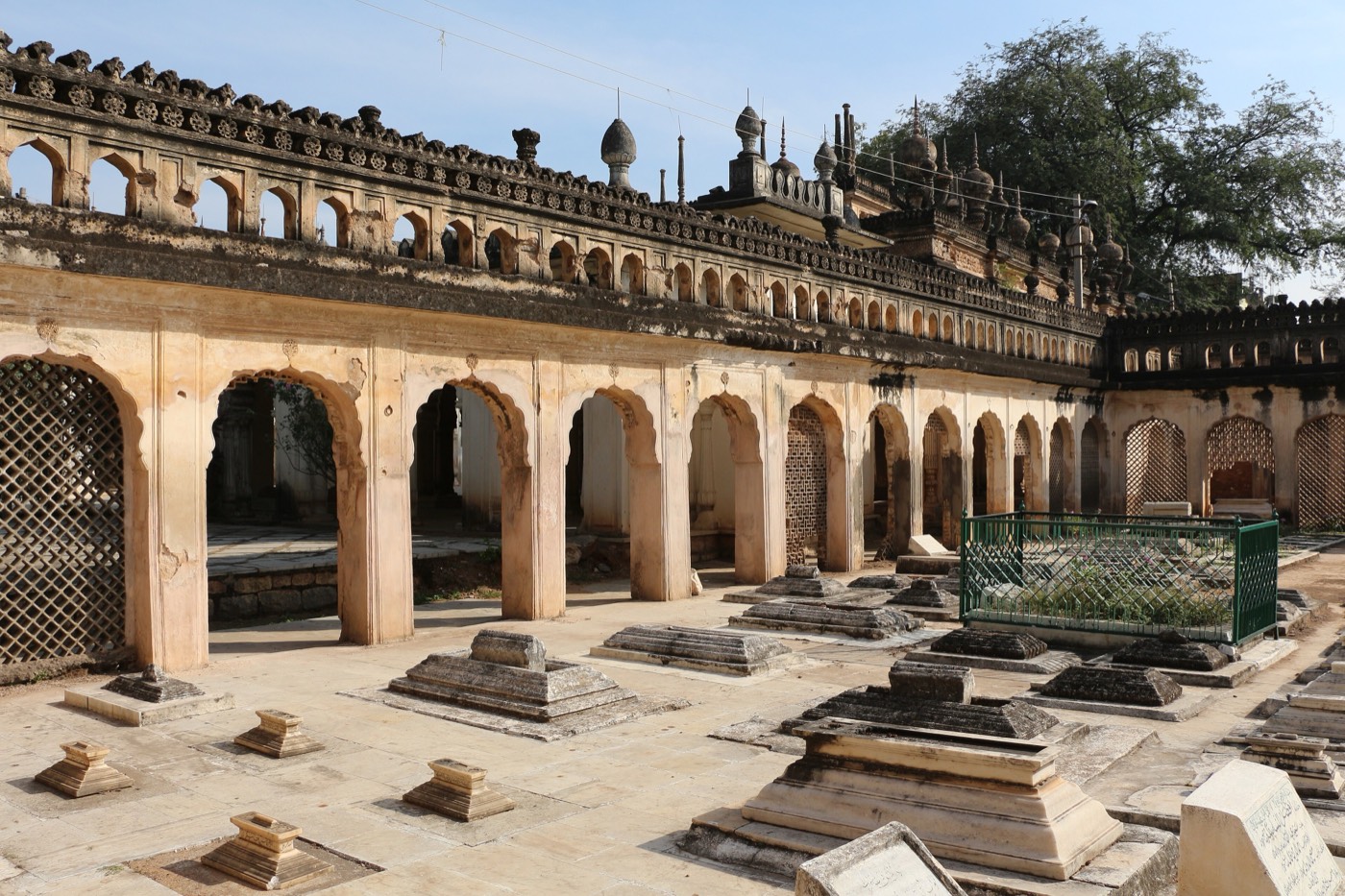
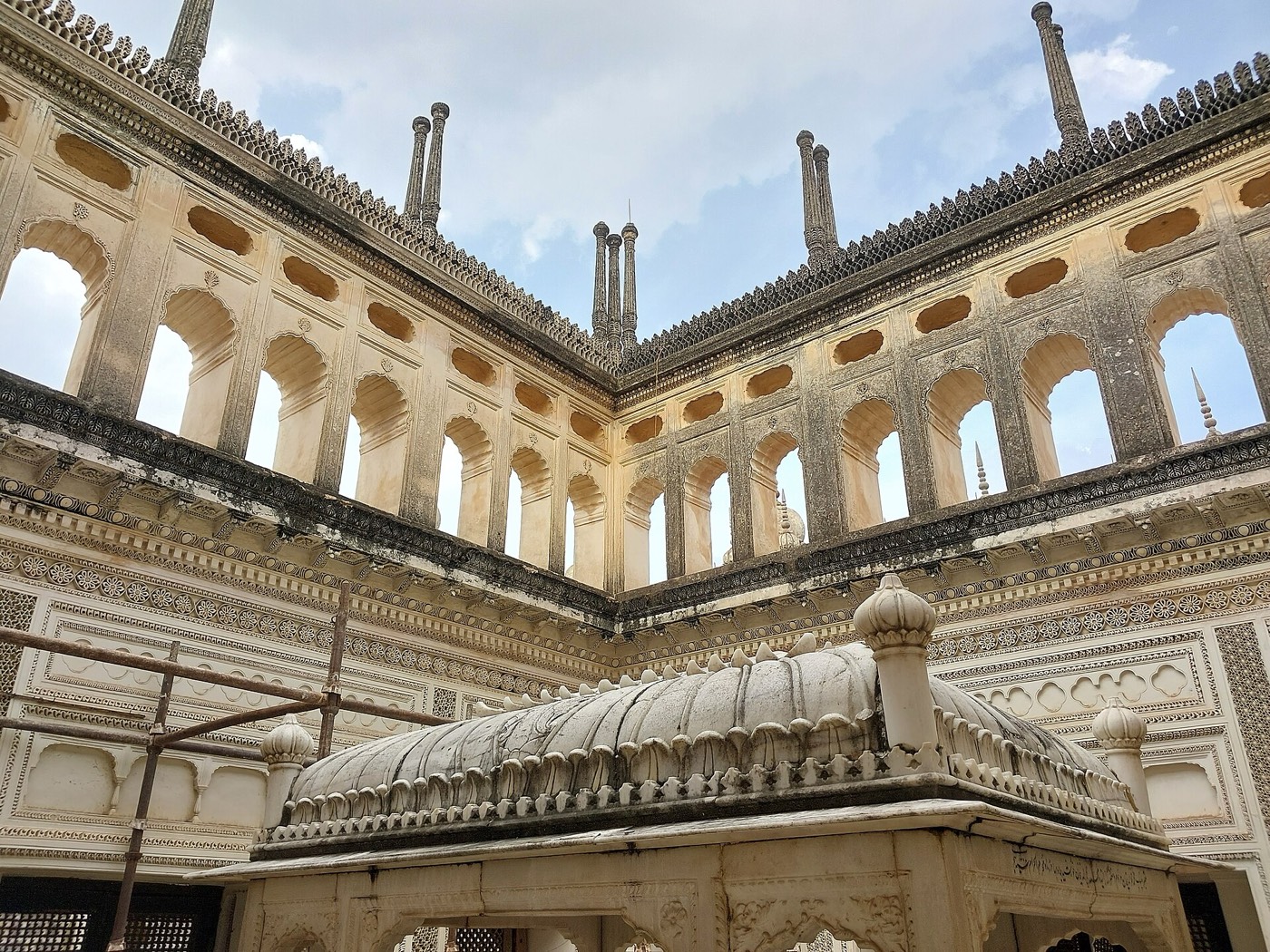
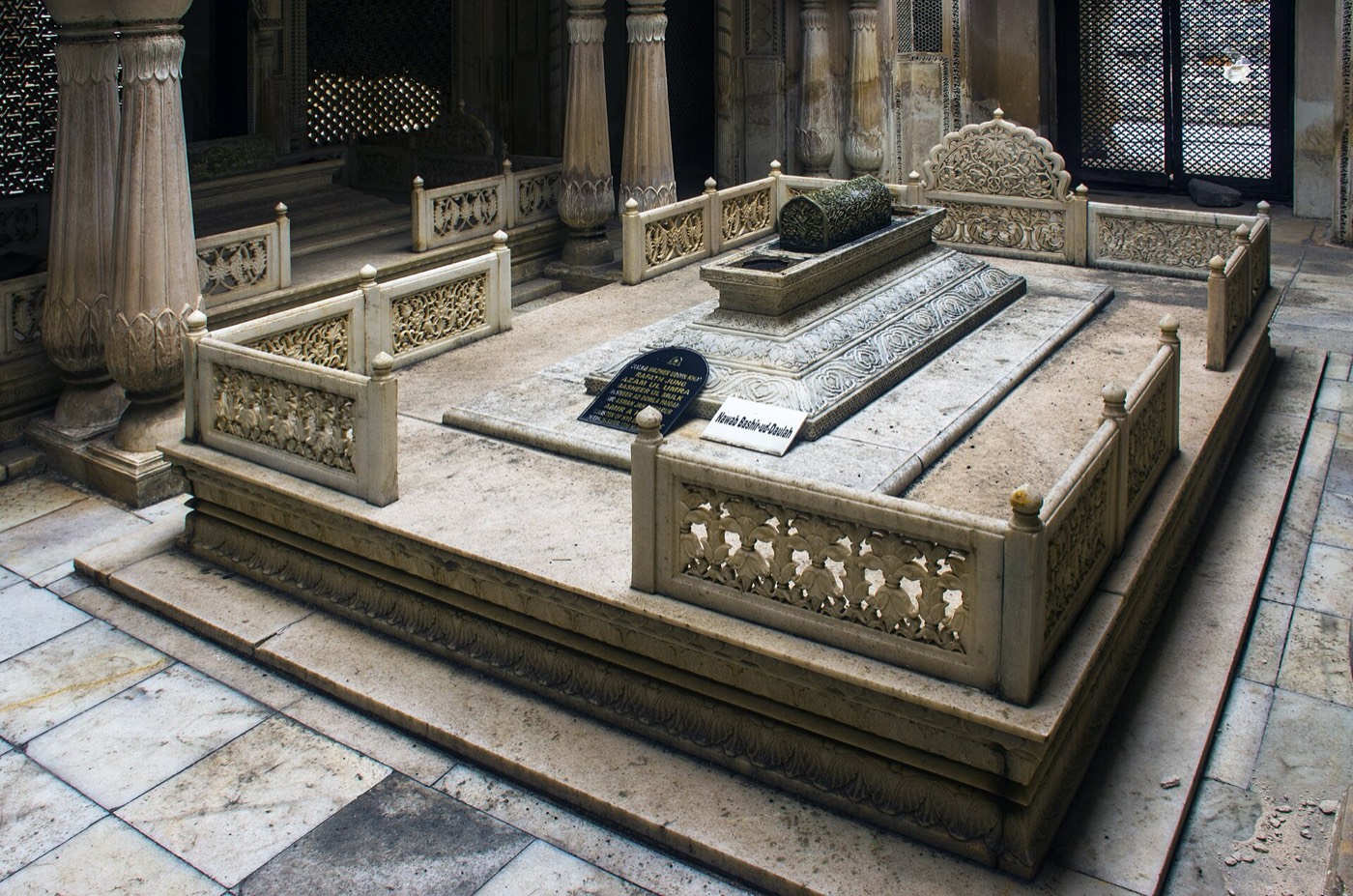
Bilgrami describes the graves in an extensive walled courtyard whose central gate has a Naubat Khana (drum house), with several marble graves under pierced marble screens finished with mother-of-pearl, mosaic and other decoration1. According to The Hindu (2025), six main tombs stand in a row, each grave open to the sky inside an arcaded walkway, and the complex is known for its incised plasterwork, surface ornament and carved marble2. AKTC’s chief executive told The Siasat Daily in 2024 that some minarets combine lime, terracotta and iron5.
The Hindu reported in 2025 that, for the lattice screens, AKTC’s craftsmen cut 2 mm terracotta tiles into small pieces, assemble them on a traced pattern and coat them with finely ground lime mortar, adding one foot at a time; working out a method that matched the original work took four to five years2. The same report says that the leaking roofs were cleaned and restored with cured limestone mortar and new drainage2.
Qué observar
- The row of six main tombs, each grave open to the sky within an arcaded walk (The Hindu, 2025)2.
- Lattice screens of thin terracotta tiles set in lime, rebuilt piece by piece (The Hindu, 2025)2.
- Marble graves under pierced marble screens, with mother-of-pearl and mosaic1.
- The founder’s grave, the first of the family burials, with its epitaph dated 1205 AH (1790)1.
- The graves of Shams-ul-Umara III and Lady Khurshid Jah, singled out by Bilgrami for their fine finish1.
Visita
- The tombs lie in Santoshnagar, where a green arch marks the entrance, according to The Hindu (2025)2.
- The family graves lie next to the older tomb of Syed Hasan Barahna Shah1.
- The conservation is one of AKTC’s projects with the Government of Telangana6; The Hindu reported in September 2025 that it was nearing completion2.
Cómo llegarAbrir en OpenStreetMapVisitas guiadas en Hyderabad