Esta parte aún no se ha traducido, por lo que se muestra en inglés.
Historia
Afzal Khan, originally Mulla Shukrullah, was a scholar from Shiraz who taught there before sailing to Surat6,7. At Burhanpur he was taken into the company of the Khan-i-Khanan, and he then served Prince Shah Jahan as law officer, secretary and then diwan, receiving the title Afzal Khan6. When Shah Jahan took the throne in 1628 he made him steward of the household and, the next year, chief diwan (diwan-i kull)6. The emperor is reported to have said that in 28 years he had never heard Afzal Khan speak ill of anyone6. He died at Lahore on 7 January 1639, aged about 70, leaving no children; he had raised his nephew Inayatullah as a son6.
The tomb carries no foundation inscription, and an ASI survey of 1891 recorded its attribution to Afzal Khan as a tradition5. The Maathir-ul-Umara, an 18th-century collection of biographies of Mughal officers, places his tomb across the Yamuna at Agra, and Syad Muhammad Latif wrote in 1896 that he was buried in a tomb he had built in his lifetime6,7. The Agra district administration dates the building to around 16351. By 1871-72 its south-western corner had collapsed, and a farmer was living inside with his family and cattle4,5. The ASI protects the tomb with its well, tank and river kiosk, and in February 2024 its Agra Circle invited bids for structural repairs2,3.
Arquitectura
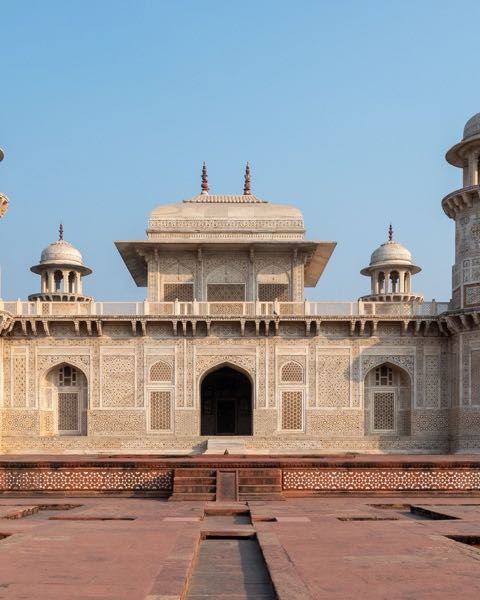
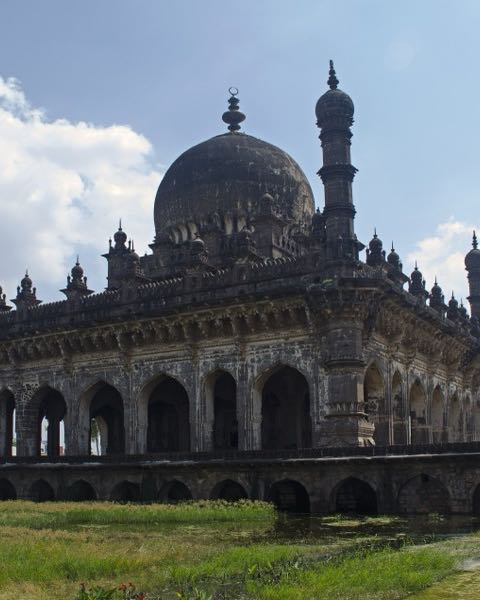
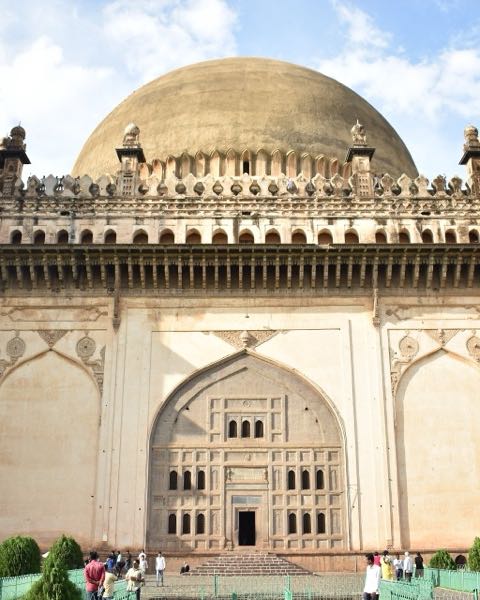
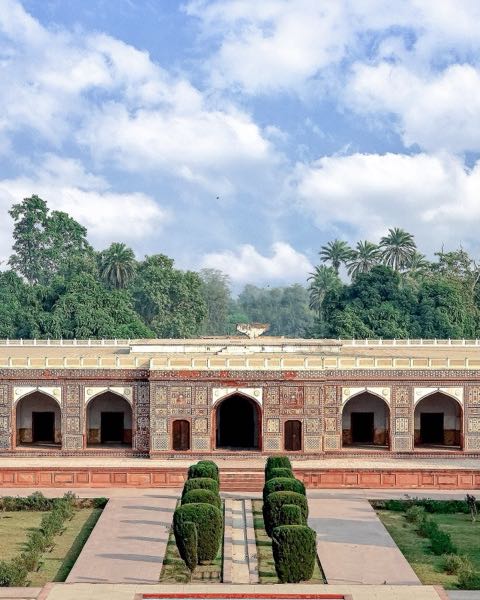
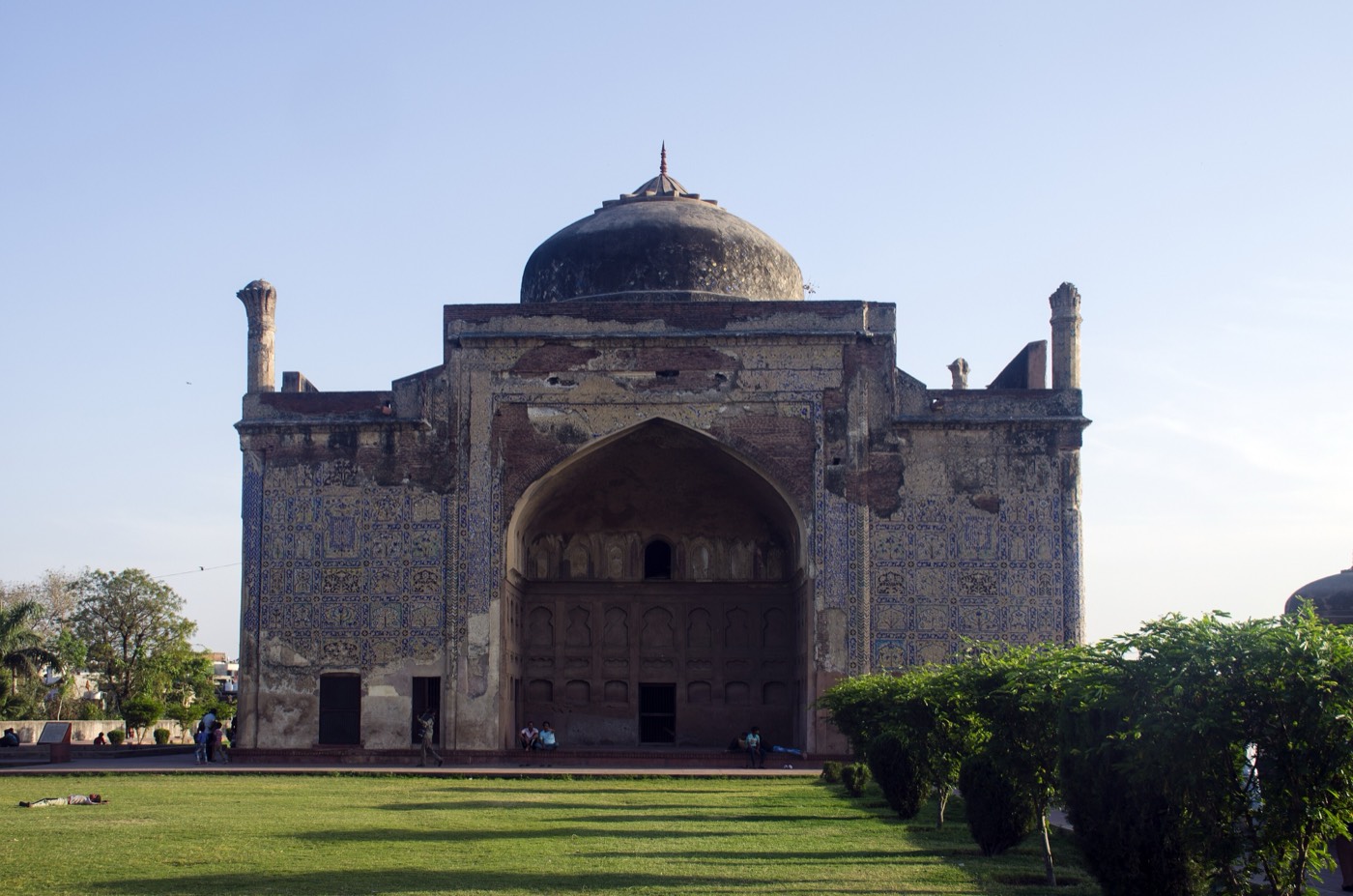
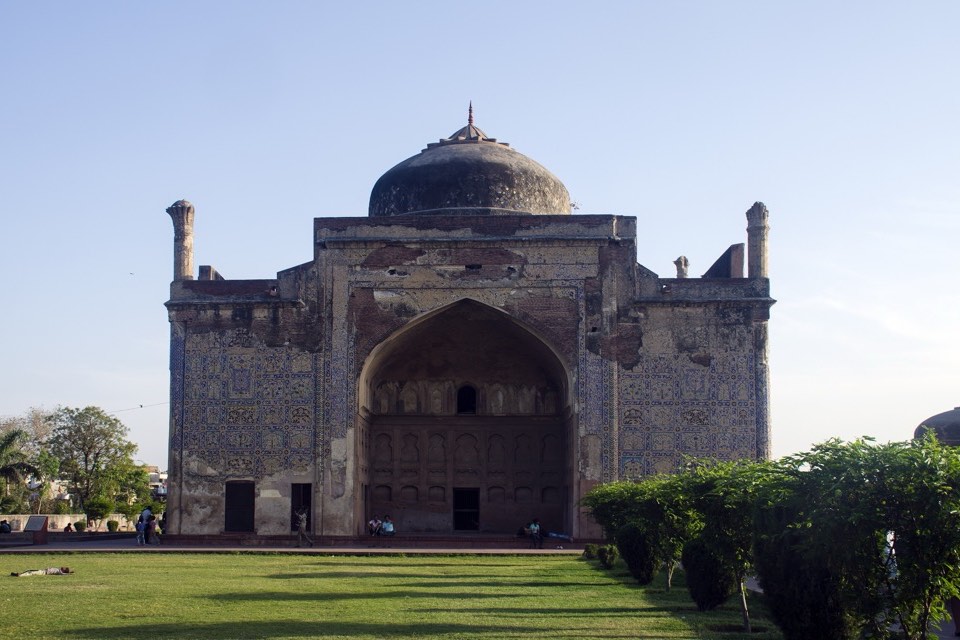
The tomb stands at the centre of the river front of a large walled enclosure, with octagonal red sandstone towers capped by pillared cupolas at the two river corners and the remains of a masonry ghat in front4,5. Unlike the older Zahra Bagh beside it, it is set square to the compass rather than parallel to the river, so its enclosure wall had to bend where it met the garden’s wall4,5. The tomb is a square block about 24 metres (79 feet) a side under a single large dome on an octagonal base; Latif described the dome as being in the old ‘Pathan’ style4,7. A lofty arch in the middle of each side opens into a hall, four square rooms fill the corners, and slender corner shafts end in flower-shaped capitals above the roof4,5.
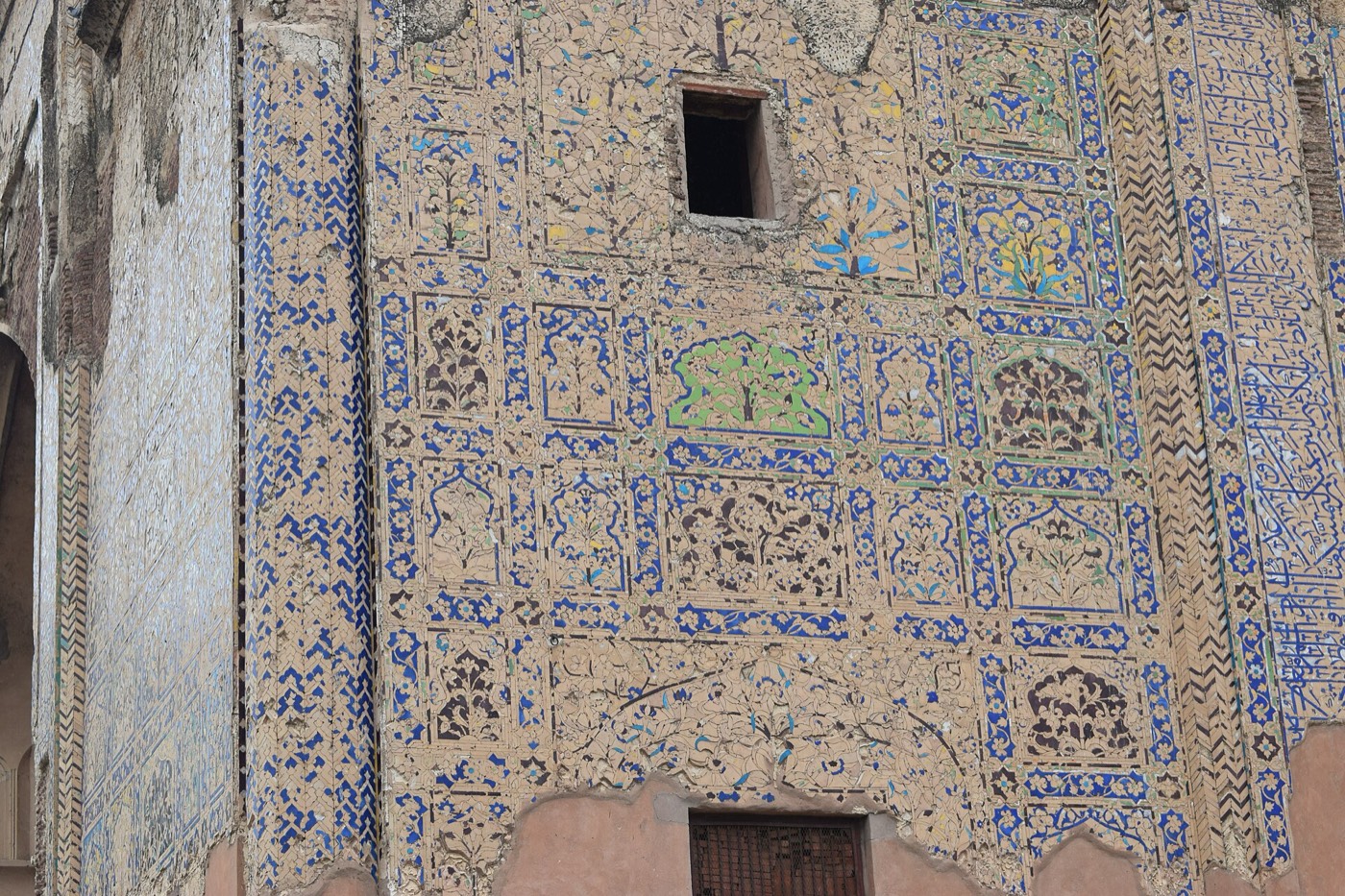
The walls were faced with glazed tile mosaic, chini or kashi work, and the Agra district administration calls the tomb the only monument in Agra faced entirely in this way1,8. Carlleyle, reporting for the ASI in 1871-72, described panels of flowers and zigzag chequer work, including half-shafts beside the arches patterned so that their three faces seem to be five; he believed, though, that the colour was one continuous coat of enamel rather than separate tiles4. Havell, writing in 1904, noted that a fallen part of the south façade showed earthen pots set in the concrete fill to lighten it8. Weather and damage have removed much of the glaze, though the district administration notes blue and turquoise tiles still on the river-facing façade1,8.
Interior
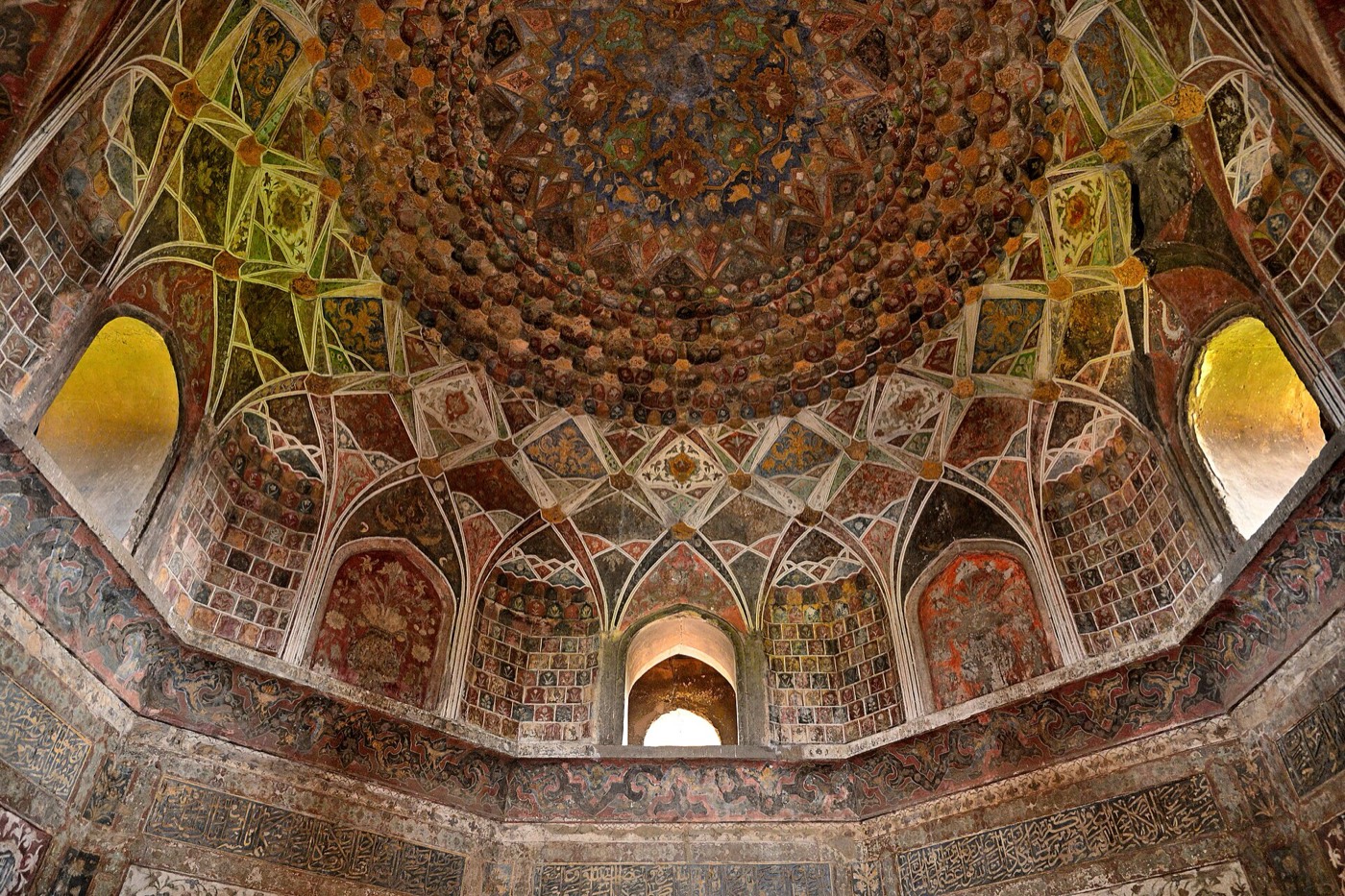
The four halls open onto a central octagonal chamber under the dome, about 8.5 metres (27 feet 10 inches) across4,5. It holds two brick cenotaphs, the larger in the centre and the other to its west; in 1871-72 they were said to have replaced two lost marble ones4,7. The walls and ceilings were painted with flowers and other designs on stucco, of which Carlleyle found only faint traces in 1871-72 in rooms blackened by smoke, and Latif saw passages from the Qur’an inscribed high in the inner chambers, already peeling in 18964,7. The real graves lay in an arched crypt beneath the building, entered from the river side, but by 1871-72 they had gone4,5.
Qué observar
- Patches of blue and turquoise tile mosaic, notably on the river-facing façade1,8.
- Zigzag tile patterns on the half-shafts flanking the arches, which Carlleyle noted make three faces look like five4.
- Slender corner shafts with flower-shaped capitals rising above the roof4,5.
- The octagonal red sandstone towers at the two river corners of the enclosure4,5.
Visita
- The tomb stands on the left (east) bank of the Yamuna, about 1 km north of Itimad-ud-Daulah’s Tomb1.
- The district administration suggests combining the visit with Itimad-ud-Daulah’s Tomb and Ram Bagh on the same bank1.
- The ASI protects it as a centrally protected monument together with its well, tank and the kiosk facing the river2.
Información oficial: Archaeological Survey of India (ASI), Agra CircleCómo llegarAbrir en OpenStreetMapVisitas guiadas en Agra