Cette partie n’a pas encore été traduite ; elle est donc affichée en anglais.
Histoire
Mama Hatun was a daughter of İzzeddin Saltuk II of the Saltukids, a Turkish dynasty based at Erzurum, and she took power in 1191 after her elder brother Nasırüddin Muhammed2. Arabic chronicles call her the lady of Erzurum, and in 1191 she led her troops to the siege of Malazgirt in support of the Ayyubid prince Taqi al-Din Umar2. In 1201 she asked the Ayyubid sultan al-Adil to find her a husband of rank, but she was deposed and imprisoned, and her nephew Alaeddin Melikşah took her place; nothing is known of her later life2.
The complex at Tercan, a town once called Mamahatun, joined the tomb to a caravanserai, a bath and a mosque on the caravan road between Erzurum and Erzincan1. No inscription names the patron or the person buried, so the link with Mama Hatun is an assumption, as Yelen and Sarı and Archnet point out5,6. Yelen and Sarı report the view that the master may have been sent from Ahlat because of the Ahlatshahs' political ties with Mama Hatun5. Evliya Çelebi, who passed through in 1640, saw a long carved marble sarcophagus and a mosque and bath near the tomb; seven years later the foundation's revenues had been seized and its buildings were falling into ruin2.
Architecture
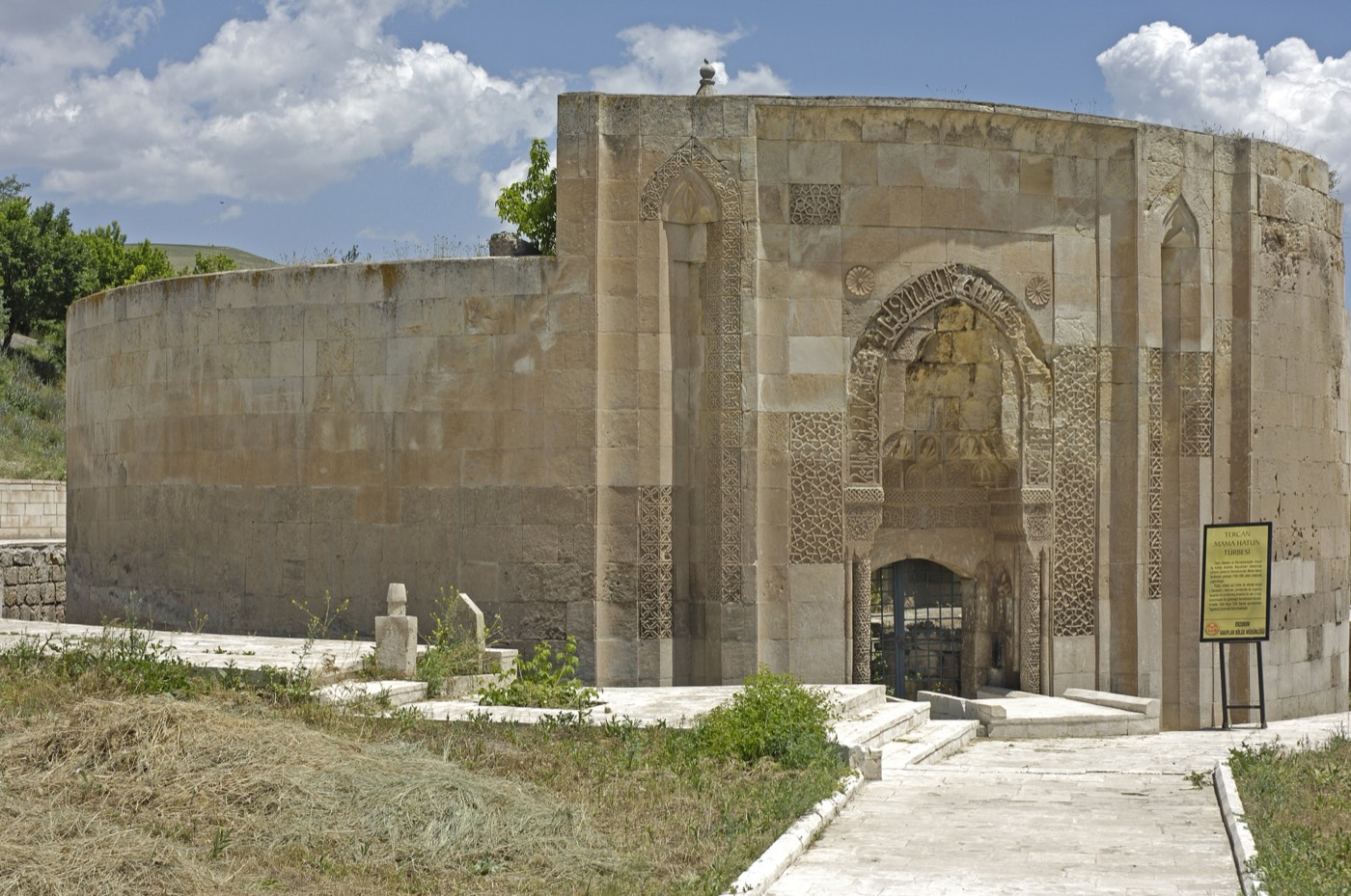
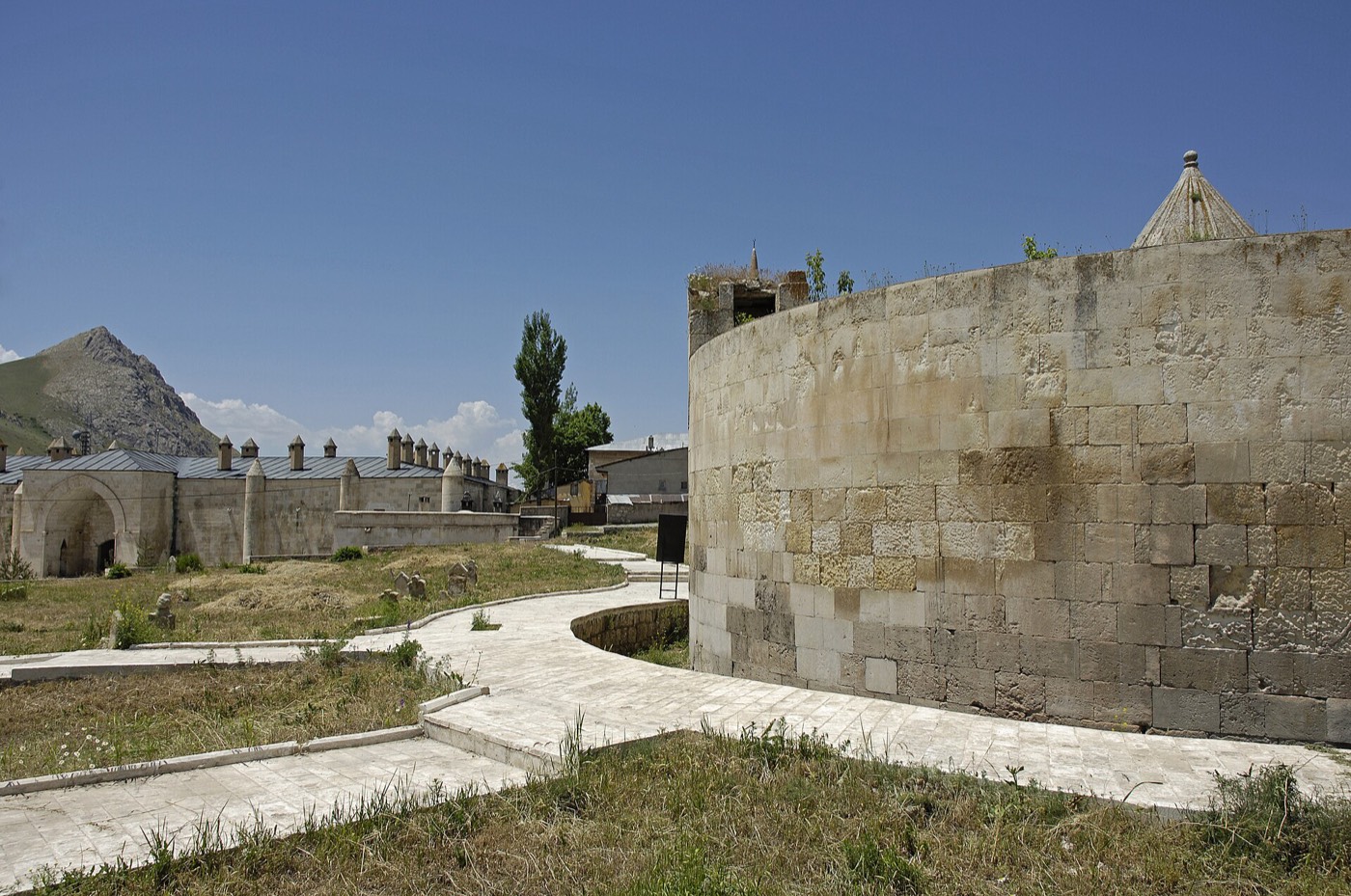
The tomb has two parts: a round enclosure wall and a kümbet at its centre1. TDV gives the wall a diameter of about 13.50 m and Erzincan's culture directorate a thickness of 2.50 m, while Archnet measures it at 17.35 m across and 4.5 m thick1,4,6. The wall is plain apart from the portal on the west; inside it is lined with pointed-arched niches, thirteen according to TDV, twelve according to Yelen and Sarı and eleven according to Erzincan's culture directorate, and the first one on the left of the entrance holds a fountain under a trefoil muqarnas arch with bunches of grapes carved beside it1,4,5. The portal's pointed arch carries Surat al-Ikhlas in Kufic script, five-pointed stars in roundels bear the names of God, Muhammad and the four caliphs, and inscriptions on the side niches name the architect1. A restoration rebuilt the damaged parts in plain stone, so only a little of the carved decoration survives1.
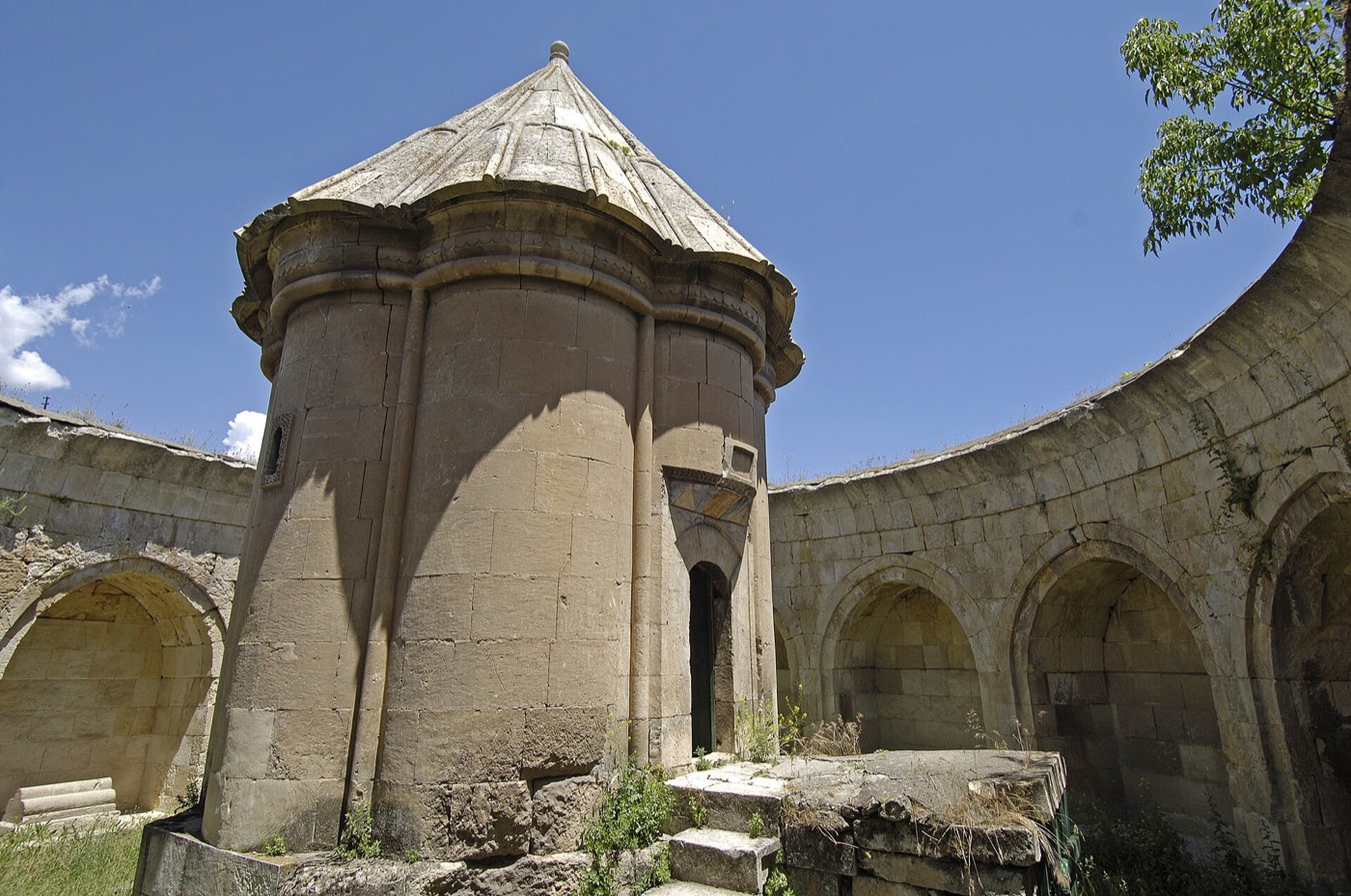
The kümbet stands on a square base whose upper corners are cut back to form an octagon1. Its round body is made of eight convex half-cylinders separated by thin roll mouldings, and the conical cap follows the same flutes1. TDV and Kültür Portalı say that no other tomb in Anatolia has this plan; TDV and Yelen and Sarı point to mausolea of the 6th to 4th centuries BC at Tagisken, east of the Aral Sea, as a distant parallel, and Yelen and Sarı also compare the ring wall with the enclosure of Momine Khatun's tomb at Nakhchivan1,3,5.
Intérieur
Through the portal one enters the open ring between the wall and the kümbet, with the niches all around; TDV says six of them hold sarcophagi thought to belong to Mama Hatun's relatives, while Yelen and Sarı count five1,5. The kümbet's door, under a flattened arch framed by a thin palmette frieze, has a blank inscription panel above it, and Erzincan's culture directorate says seven steps lead up to the upper room1,4. Inside, the walls repeat the flutes of the exterior and their mouldings meet at the top of the dome like ribs, and the slit windows carry grapes, palmettes and rumi scrolls1,4. Four steps lead down to the square, cross-vaulted crypt, which holds the sarcophagus traditionally taken to be Mama Hatun's; Erzincan's culture directorate, citing the historian T. Erdoğan Şahin, notes that the carved marble sarcophagus seen by Evliya Çelebi has been replaced by a later, symbolic one1,4.
À observer
- The west portal, with Surat al-Ikhlas in Kufic and the names of the four caliphs in star roundels1.
- The architect's signature, Ebü'n-Nemâ b. Mufaddal of Ahlat, in the portal's side inscriptions1,5.
- The ring of arched niches inside the wall, one of them a fountain carved with grapes1.
- The eight convex flutes of the kümbet, carried up into its conical cap1.
- The caravanserai next door, 51 × 51 m, built in the early 13th century1.
Visite
- The complex is in the Mamahatun quarter of Tercan, on Kervansaray Caddesi, beside the old road between Erzincan and Erzurum1,3.
- The caravanserai stands about 30 m east of the tomb, with the small bath between them1,4.
- The complex's mosque was destroyed and a new mosque was built in its place1,4.
Informations officielles: Republic of Türkiye Ministry of Culture and Tourism (Kültür Portalı) and the Erzincan Provincial Directorate of Culture and TourismItinéraireOuvrir dans OpenStreetMapVisites guidées : Tercan