Turbehتربة

Ein Atlas islamischer Mausoleen

TafelXXXVIIvon CIII

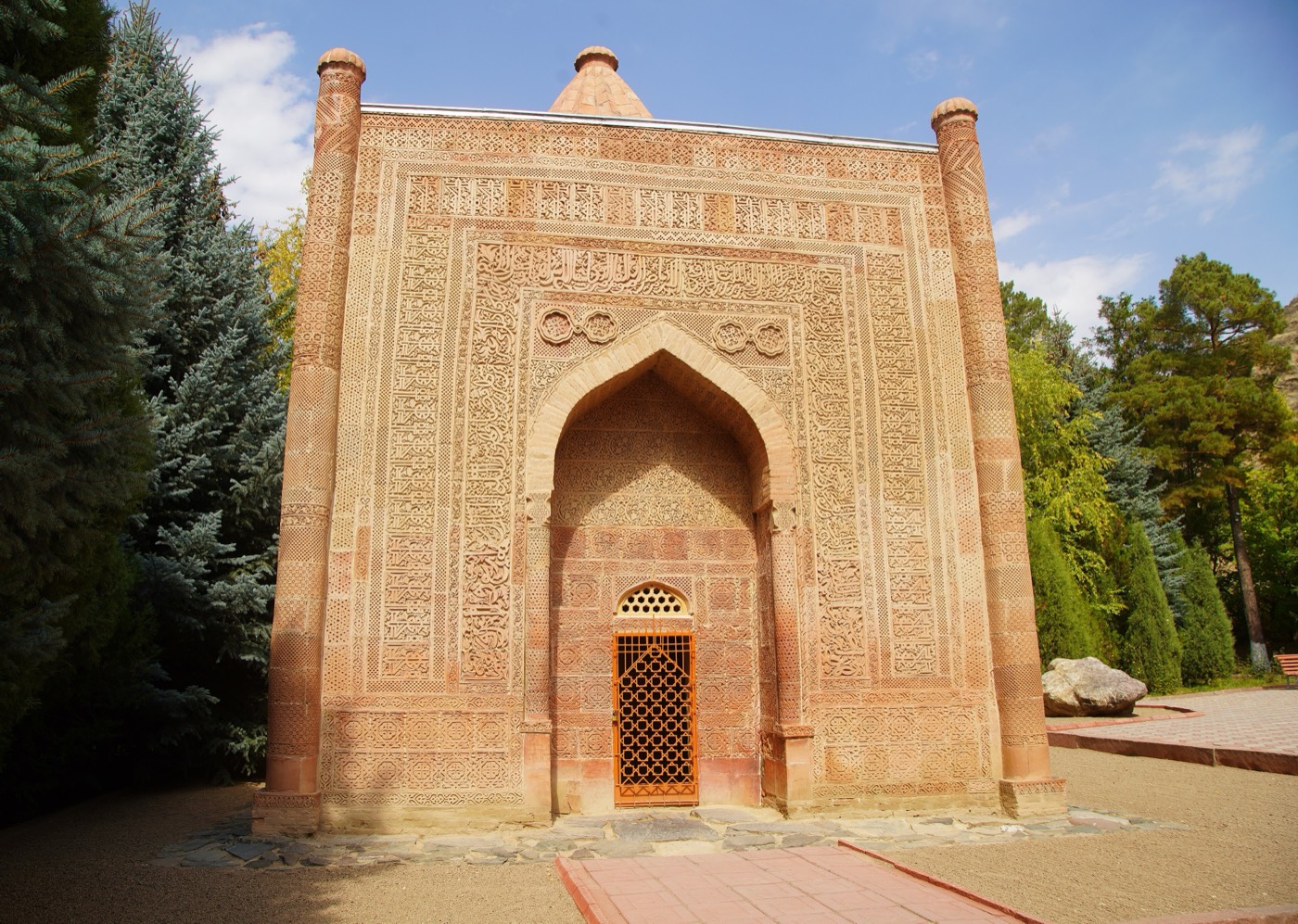
Manas Gumbez (Mausoleum von Kenkol)

قبة ماناس (ضريح كينكول)Манас күмбөзү Manas kümbözü

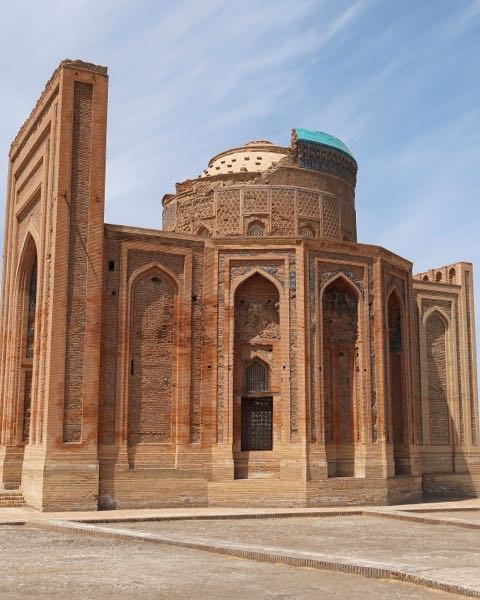
Ein Grabbau aus Ziegel von etwa 1334 mit einem Portal aus geschnitzter Terrakotta im Talastal; seine Inschrift nennt Kenizek-Khatun, doch die Legende hält ihn für das Grab des Epenhelden Manas1,2,7.

Erbaut
um 1334 n. Chr.
um 734–735 n. H.
Archnet, following M. E. Masson and G. A. Pugachenkova, who studied the inscriptions and the architecture, dates the building to about 1334 (734 AH)1.
Epoche
Tschagatai-Khanat (Zeit der Tschagataiden)
Erbaut für
Kenizek-Khatun, Tochter des Emirs Abuka, die in den Portalinschriften genannt wird: laut der Großen Sowjetischen Enzyklopädie wurde der Bau als ihr Grab errichtet, Archnet dagegen nennt sie seine Stifterin1,7; der Legende nach ist er das Grab des Epenhelden Manas2,7
Materialien
Gebrannter Ziegel in Lehmmörtel; Platten aus geschnitzter Terrakotta am Portal; Fenstergitter aus Gipsstuck (Gantsch) in den Seitenwänden1
Ort
Bei Talas, Kirgisistan
Manas Gumbez (Mausoleum von Kenkol)
Foto: Mheidegger · CC BY 4.0 · Wikimedia Commons

Dieser Teil ist noch nicht übersetzt und wird daher auf Englisch angezeigt.

Geschichte

The Kyrgyz epic of Manas tells of a hero who, in legendary tradition, brought the Kyrgyz back from the Altai to the Tien Shan, united them and defended them against Chinese raids; its classic version took shape in the 18th century2. In 2013 UNESCO inscribed the trilogy of Manas, Semetey and Seytek on its Representative List of the Intangible Cultural Heritage of Humanity2,3. Folk belief placed Manas’s headquarters, his ordo, in the Talas valley, and in one version of the epic his widow Kanykei has a tomb built for him by a master brought from Rum2,6. The 14th-century mausoleum on the Kenkol River, near where it joins the Talas, came to be popularly regarded as Manas’s grave1,2.

Archnet, following the Soviet scholars M. E. Masson and G. A. Pugachenkova, dates the building to about 1334, under the Chaghatayid khans1. Its portal inscriptions name Kenizek-Khatun, daughter of the emir Abuka: the Great Soviet Encyclopedia calls the building her tomb, while Archnet calls her its patron1,7. Its burials, like those of the Burana and Uzgen mausoleums, lay in pits oriented north-south, the usual Muslim arrangement5. Soviet researchers began systematic work in the Talas valley in the 1930s and 1940s2. A literary and ethnographic museum opened here in 1976, becoming a state museum-reserve in 1990; its rebuilding began in 1995, when Kyrgyzstan celebrated the epic’s 1000th anniversary under UNESCO’s auspices, and the Manas Ordo complex opened in 1996, gaining national status in 20012.

Architektur

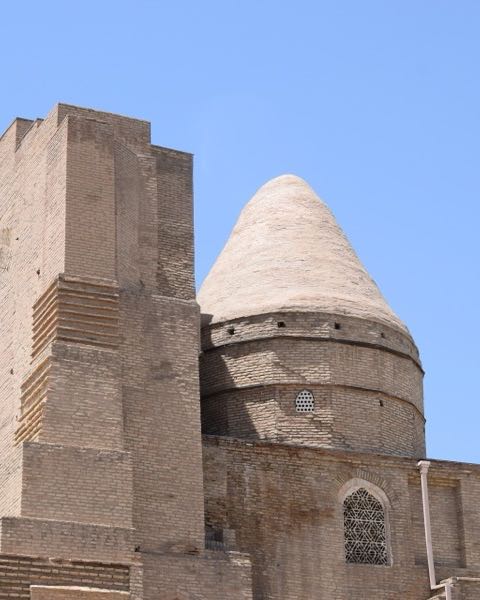
The mausoleum is a small, near-square building of baked brick laid in clay mortar, whose façade is dominated by a large portal (pishtaq) and a pyramidal dome1. The outer dome, sixteen-sided and ribbed, hides an inner dome with a pointed (lancet) profile1. The Great Soviet Encyclopedia notes that this ribbed outer roof was restored in 1969-19707. Engaged columns topped by small cupolas frame the portal, which is covered with carved terracotta slabs, while the side walls are plain1. Four eight-petalled medallions fill the spandrels of the portal arch, and the terracotta frames carry geometric patterns and inscriptions in Kufic and a cursive script1.

Archnet sees in it the influence of earlier tombs of the Talas valley, such as that of Babaji-Khatun1. A 2025 study of Chaghatayid architecture names Manas Gumbez and the tomb of Tughluq Timur near medieval Almaliq, in China, as the best-known Chaghatayid monuments4.
Innenraum

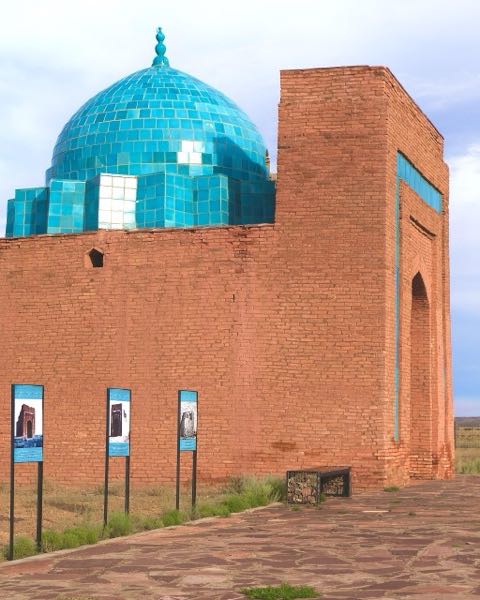
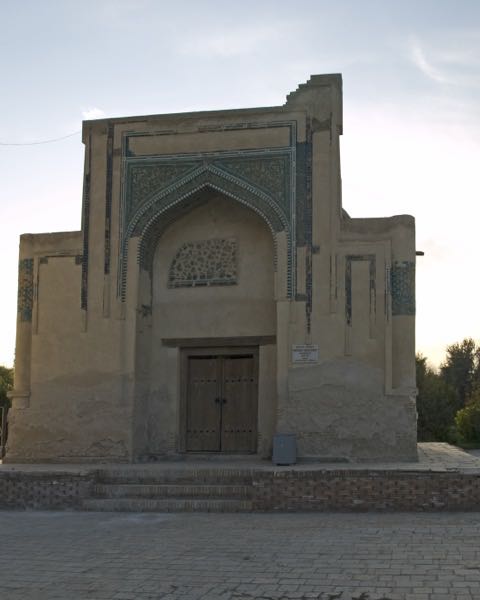
Archnet records that the chamber’s floor was paved with baked brick and that the window lattices of its side walls were made of ganch, a gypsum plaster1. The dome seen from inside is the inner shell, with its pointed lancet profile, which the sixteen-sided outer dome conceals from view outside1.

Besonders sehenswert

  1. The carved terracotta portal, with Kufic and cursive inscriptions naming Kenizek-Khatun1.
  2. Four eight-petalled medallions in the spandrels of the portal arch1.
  3. The sixteen-sided ribbed pyramidal outer dome, rising behind the portal1.
  4. Engaged columns topped by small cupolas framing the portal1.

Besuch

  • The mausoleum is the centrepiece of the Manas Ordo complex, which opened in 19962.
  • It stands on the bank of the Kenkol River near its confluence with the Talas, along the Kyrgyz (Kirghiz) Range1.
  • Since the 1990s the complex has been one of Kyrgyzstan’s main symbols of nation and statehood2.

Quellen

  1. Archnet (Aga Khan Documentation Center, MIT Libraries): Maqbara-i Manas
  2. Society and Security Insights (Altai State University), vol. 6, no. 3 (2023); I. V. Oktyabrskaya: Центральная Азия: историко-культурное наследие в структуре межнациональных отношений конца ХХ — начала XXI века
  3. UNESCO Intangible Cultural Heritage, Representative List (inscribed 2013, element 00876): Kyrgyz epic trilogy: Manas, Semetey, Seytek
  4. Gumilyov Journal of History, vol. 153, no. 4 (2025), pp. 45-58; O. Oshanov (Margulan Institute of Archaeology): Two Chagatai Mausoleums in the Trans-Ili Alatau (Based on Archaeological Research)
  5. MANAS Journal of Social Studies (Kyrgyz-Turkish Manas University), vol. 8, no. 1 (2019), pp. 584-611; K. Tabaldiev and K. Akmatov: Мавзолей Кёк-Таш (Көк-Таш) (Результаты археологических раскопок 2017 года)
  6. Journal of Turkic Civilization Studies, vol. 7, no. 1 (2026), pp. 74-85; Kaliya Kulaliyeva: «Манас» эпосундагы жер-суу аттары («Манас» эпосунун сюжеттик-тематикалык көрсөткүчүнүн негизинде)
  7. Great Soviet Encyclopedia (Bolshaya sovetskaya entsiklopediya), 3rd ed., Moscow: Sovetskaya Entsiklopediya, 1969-1978 (text on the website of the Vologda Regional Universal Scientific Library): Манаса мавзолей

Bilder und 3D