Dieser Teil ist noch nicht übersetzt und wird daher auf Englisch angezeigt.
Geschichte
Archnet describes the Ishratkhana as a dynastic tomb for the royal women of the Timurid house, probably meant to succeed the Shah-i Zinda, in use until the 1440s4. According to Archnet, Abu Sa’id’s eldest wife, Habiba Sultan Begim, commissioned it in 1464 for a daughter who died young4. A 2022 article published by UzA, the national news agency, cites the waqf deed known from the archive of the Samarkand State Museum-Reserve: dated to the start of Ramadan 868 AH (May 1464), it bears the seal of Abu Sa’id, ruler of Transoxiana and Khorasan5. The deed calls the building the mausoleum of Sultan Khovand Beka, built by Habiba Sultan Begim, daughter of Amir Jalal al-Din Suhrab, beside the tomb of Khoja Abdi Darun5.
The endowment, half the lands of Malik Saray village, paid a Qur’an reciter, a supervisor and a servant, all lodged upstairs5. The crypt became a family vault: Archnet counts 20 tombstones there in the late 17th century, UzA 20 excavated graves, and the Registan Ensemble Directorate 23 burials of women and children4,5,6. According to UzA, no source but Abu Tahir Khoja’s Samariya of the 1830s uses the name Ishratkhana, ‘house of pleasure’; Archnet links it to the rich interiors, and the Directorate treats as legend the story that Timur admired the building and made it a house of joy4,5,6. Specialists of the Samarkand State Museum-Reserve prefer Ashratkhana, ‘ten rooms’, now the form in Uzbekistan’s national heritage register5,6.
Architektur
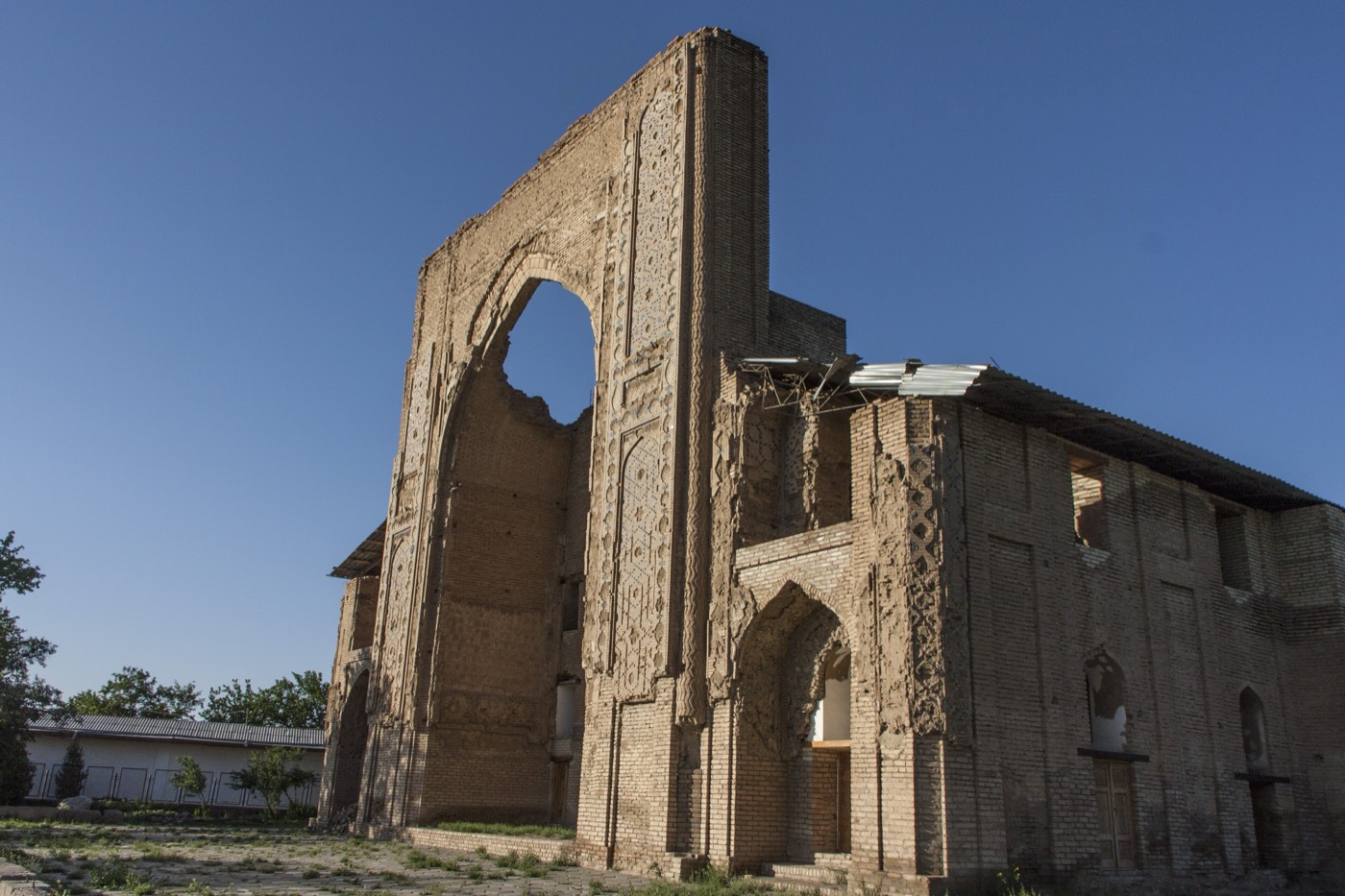
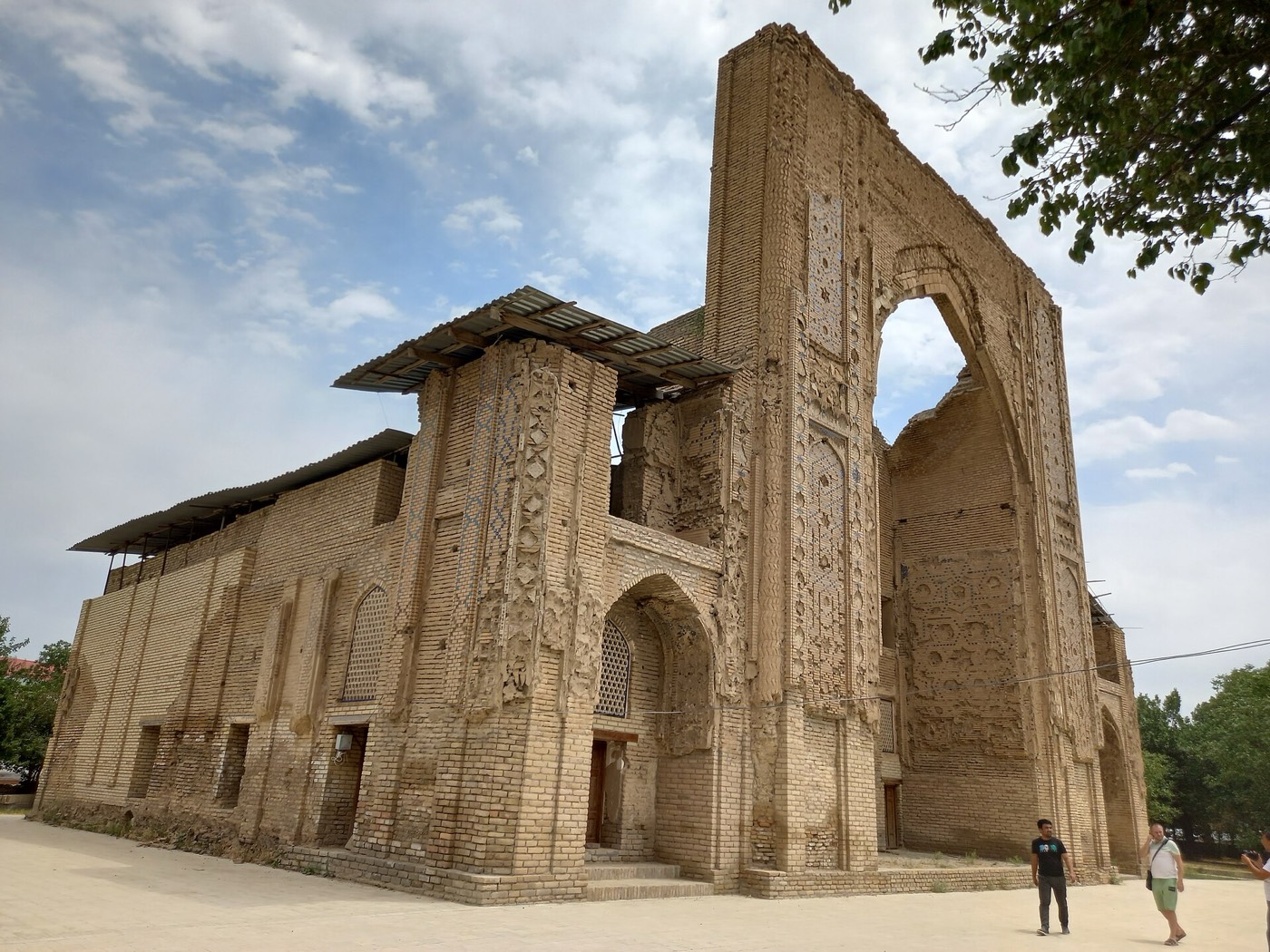
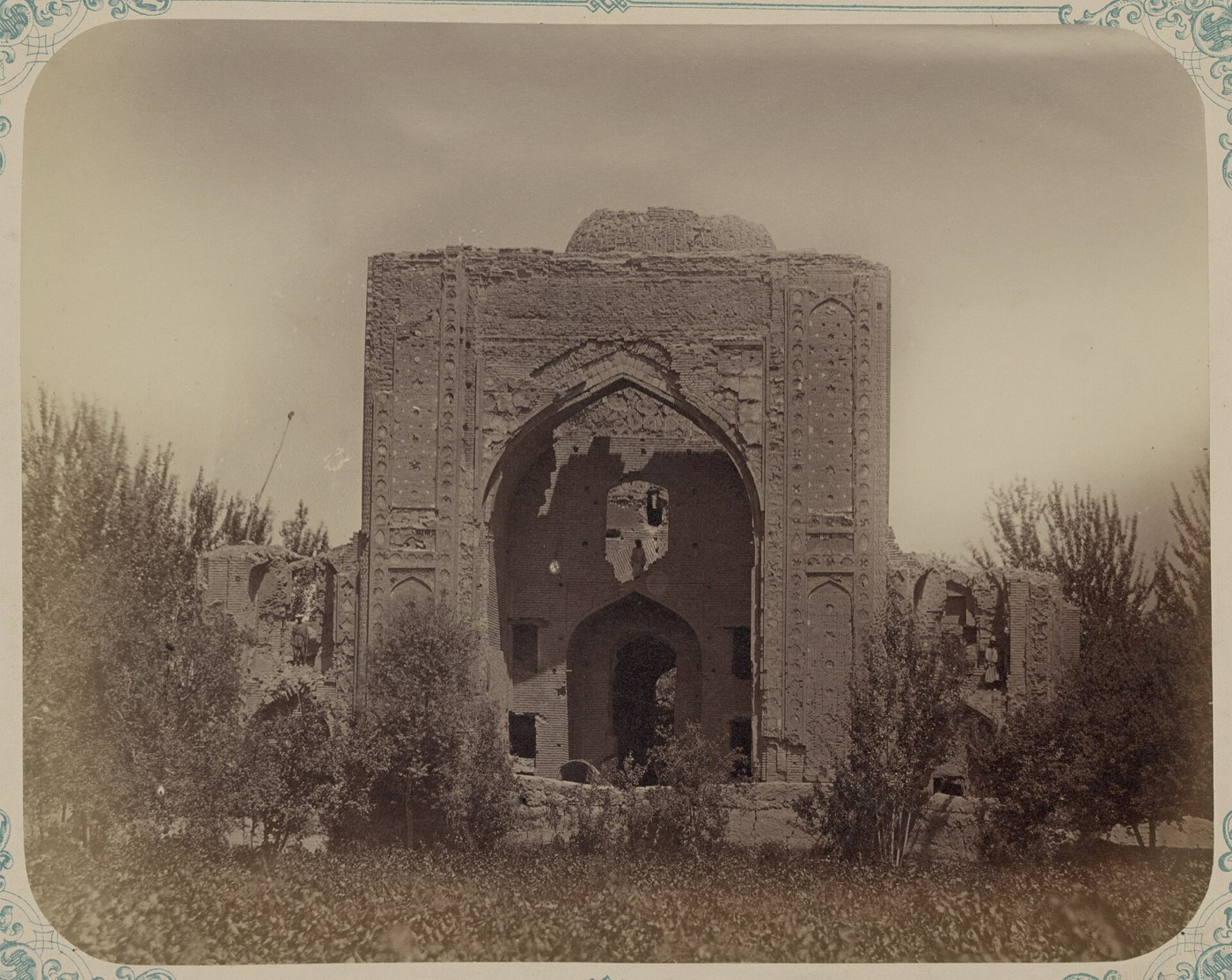
The plan, which Archnet counts among the later Timurid tripartite types, places a tall cruciform domed hall between a three-room mosque on the west and four rooms on the east, the miyan saray, used for funeral rites4. Spiral stairs in the corner piers lead to upper rooms, and another stair descends to a vaulted octagonal crypt4,5. Archnet describes a flat, 16-sided inner dome over the hall, carried on intersecting arches, under a tiled outer dome on a tall drum; V. Vyatkin, a former head of the Samarkand museum, put the top of the outer dome 26.7 m above the ground, as UzA reports4,5. The tall portal has two-storey loggias, glazed brick and mosaic panels with interlocking hexagonal stars4,6.
According to UzA, Galina Pugachenkova (1976) and Lisa Golombek and Donald Wilber (1988) compared the design with Gawhar Shad’s mausoleum in Herat5. The building was neglected after the Shaybanids replaced the Timurids, and according to UzA its tombstones were moved to the Abdi Darun cemetery in the 17th century and re-inscribed5. UzA reports that an earthquake in 1897 brought down four rooms and that the domes of two rooms fell in 1902; Archnet dates the collapse of the central dome and drum to 19034,5. Archnet notes that the tomb was left out of the Soviet restoration campaigns of the 1930s to 1970s4.
Innenraum
Archnet describes the interior decoration: a mosaic dado to eye level, with kundal above it, a relief of red clay, plaster and glue covered with gold leaf and white lead, and windows of coloured glass, rare in the region at the time4. Traces of hexagonal stars in relief remain on the drum, and the nomination file also mentions marble panels and paintings with gold3,4. According to UzA, Steffen Laue led students from Potsdam in Germany and from the Samarkand State Architecture and Construction Institute in 2007 in analysing the pigments and restoring part of the wall decoration5. The same 2022 article describes the building as partly conserved, with its roofs covered, but not yet set up as a museum5.
Besonders sehenswert
- The tall portal with two-storey loggias and remains of glazed brick and mosaic4,6.
- Traces of hexagonal stars in relief on the remains of the drum4.
- The cruciform central hall between the mosque rooms on the west and the miyan saray on the east4.
- The stair down to the octagonal burial crypt4,5.
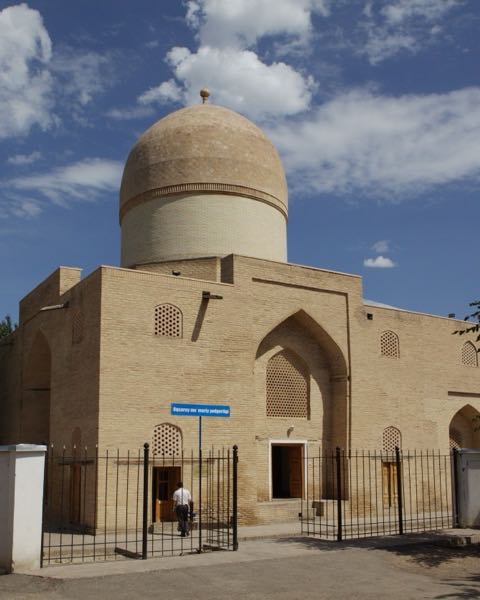
- The neighbouring Khoja Abdi Darun ensemble, part of the same World Heritage component1,5.
Besuch
- UNESCO lists the Ishratkhana and the Abdi Darun ensemble together as one component of the World Heritage property1,2.
- UzA places the mausoleum south-east of the Registan, at the edge of the old town, near Sadriddin Ayni Street5.
- It is a partly conserved ruin and, according to UzA in 2022, not set up as a museum5.
Offizielle Informationen: State Samarkand Historical-Architectural Reserve, under Uzbekistan’s culture ministry and the Samarkand regional government (as described by UNESCO)AnfahrtIn OpenStreetMap öffnenFührungen in Samarkand