Dieser Teil ist noch nicht übersetzt und wird daher auf Englisch angezeigt.
Geschichte
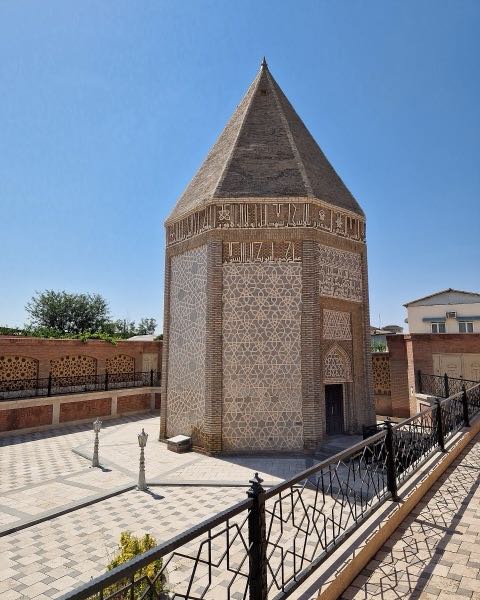
Barda’s tomb tower was built by Ahmad ibn Ayyub al-Hafiz of Nakhchivan and, according to its building inscription, completed in 13221,2,6,7. Encyclopaedia Iranica calls him one of the best representatives of the Nakhchivan school of architecture, and the Presidential Library of Azerbaijan credits him and Ajami ibn Abi Bakr with a large part in creating the tower tombs of Azerbaijan4,6. Who was buried here is not recorded; an official briefing in 2018 presumed a member of the Ilkhanid dynasty2. The tomb stands inside an enclosure of defensive walls known as Torpaqqala2. Its pattern of brick and tile repeats the word Allah, and the building is popularly called the “Allah-Allah” tomb2.
The tomb was long neglected1,2. A 1960s restoration changed its appearance: the inscriptions were erased, and a heavy concrete structure on top caused cracks2. New work, which official accounts date to 2011 or 2012, was commissioned by the State Service for the Protection, Development and Restoration of Cultural Heritage and carried out by the Azerbarpa institute2,5. The concrete dome was taken down, rebuilt and faced with glazed brick, using 427 m² of glazed elements, and the Throne Verse (Ayat al-Kursi) and the Kufic inscriptions were restored2. A marble cenotaph was placed in the crypt and the Torpaqqala walls around the two-hectare site were restored; President Ilham Aliyev viewed the finished work on 25 March 20182.
Architektur
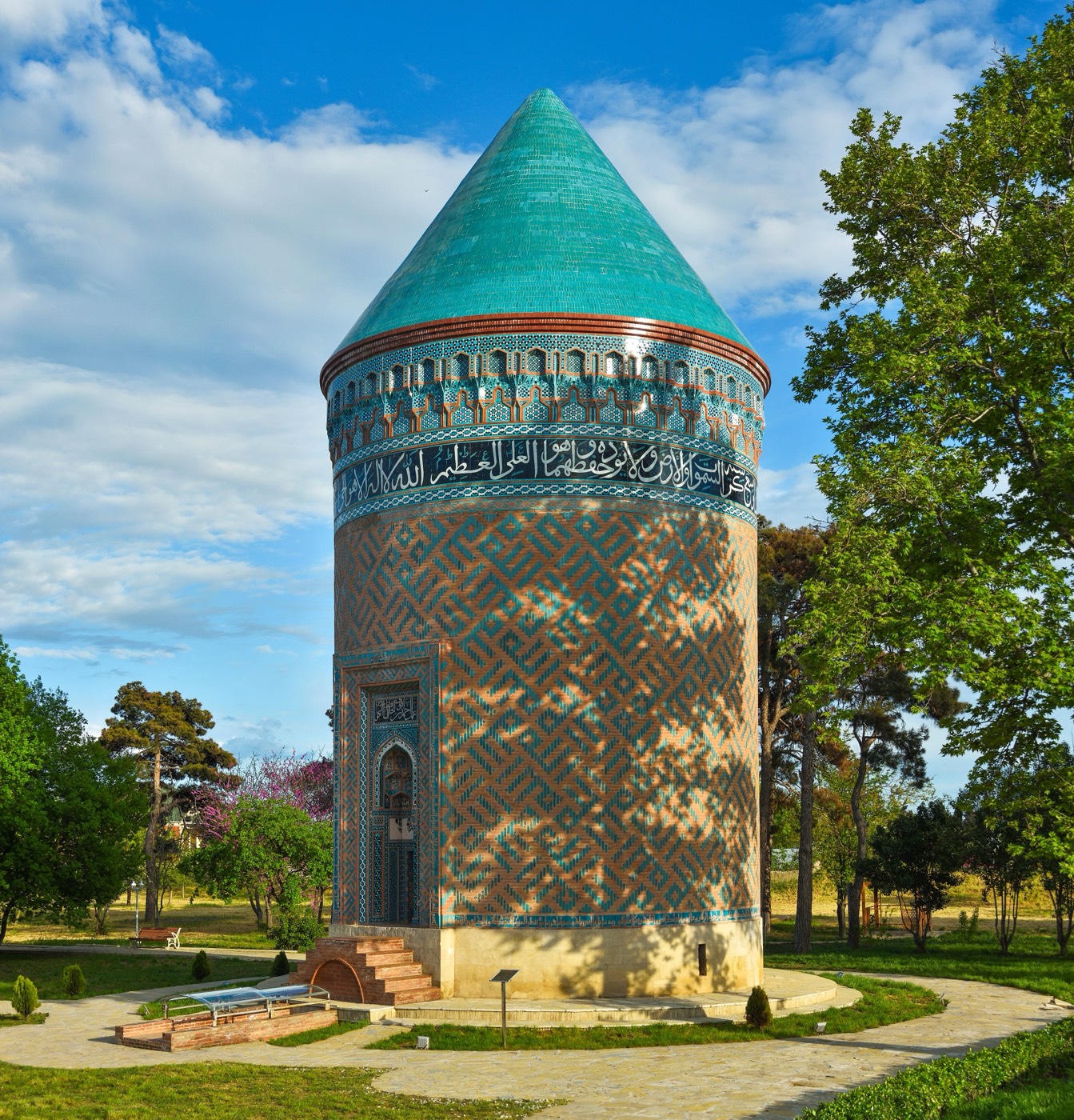
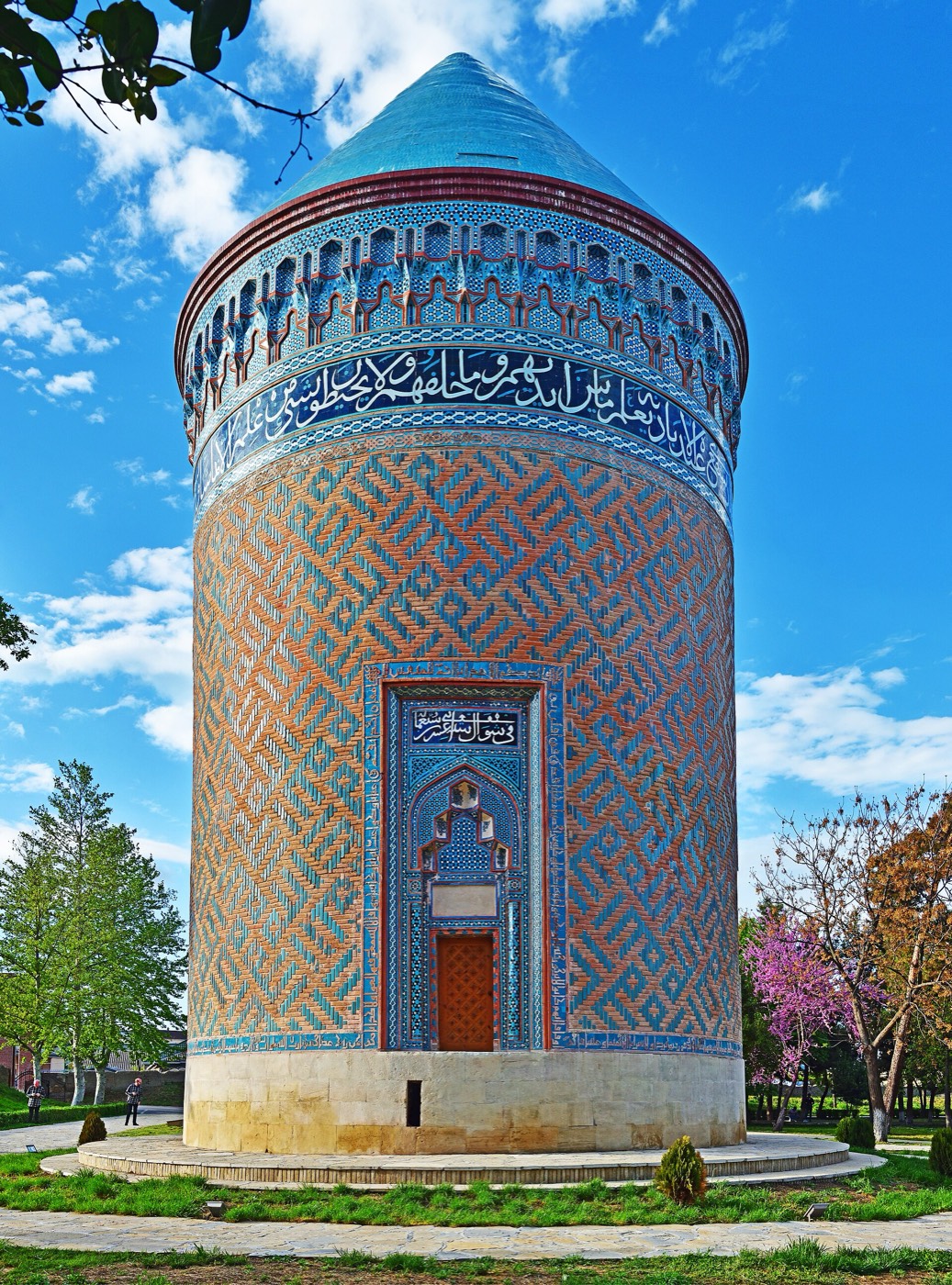
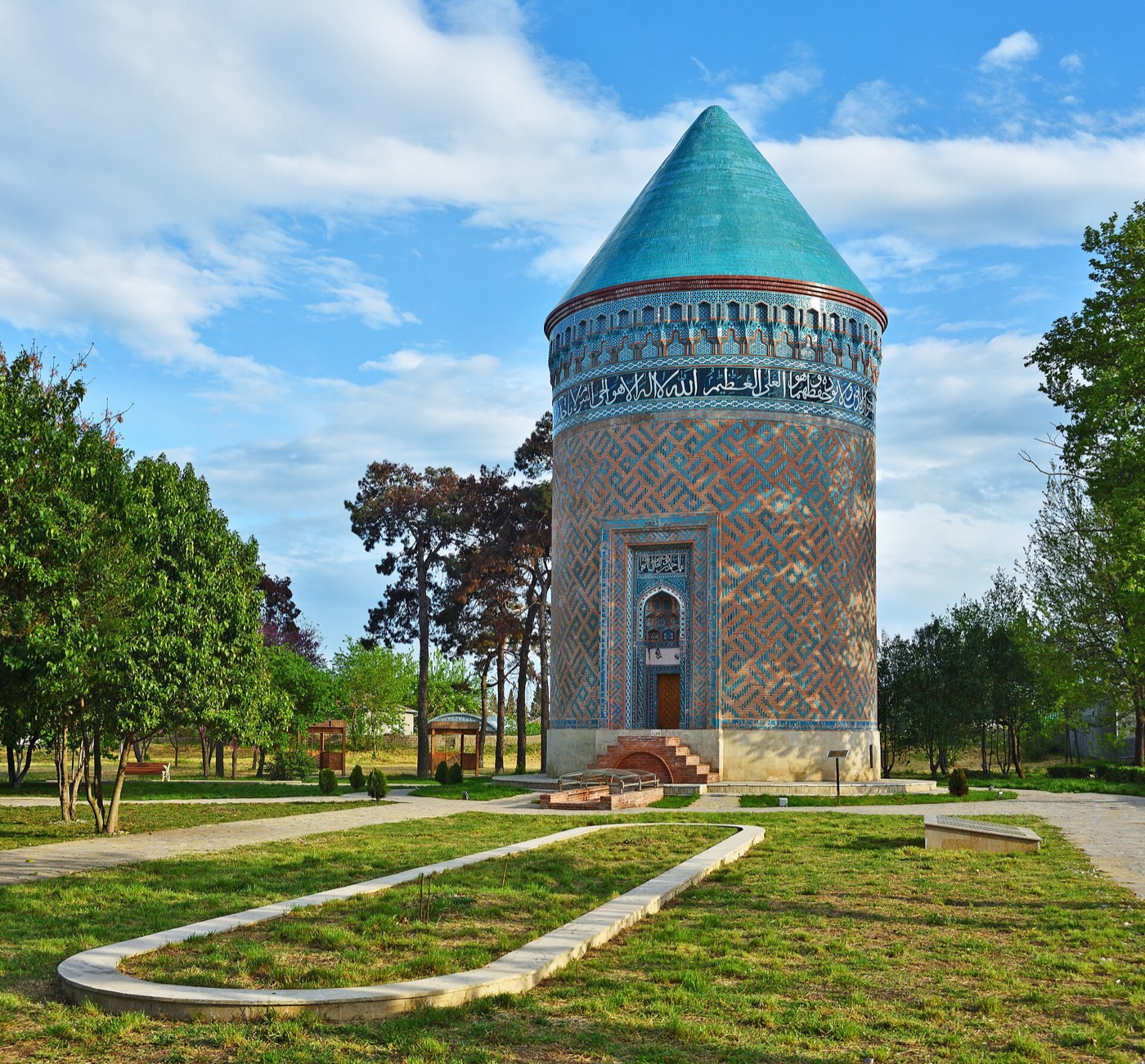
The tomb has two levels: a crypt for the burial below ground, an arrangement the 2018 account calls typical of the period, and a memorial tower above1,2. Outside, the tower has three parts, a stone plinth, a cylindrical brick body and a conical roof1,2,7. Iranica gives a height of 14 m (as does Archnet) and a diameter of 10 m; the official accounts give 13 m and 10 m (2018) and a height of 12.5 m (2015)1,2,6,7. Two portals, facing north and south, have muqarnas hoods, and Iranica singles out the northern one for its composition, play of light and shade and rich ornament6,7.
From the plinth to the upper border the body is covered by a single composition of turquoise glazed tile and red brick in which the word Allah is repeated, written in Kufic according to Archnet2,7. A broad frieze at the top of the body has a Qur’anic inscription in its central band, and inscriptions of the Throne Verse (Ayat al-Kursi) and in Kufic script were restored in 2012-20182,6. The Presidential Library of Azerbaijan compares the tomb with the Garabaghlar tomb in Nakhchivan, also of the early 14th century: there the Shahada, repeated in lozenges of glazed and plain brick, recalls Barda’s ornamental inscription, and the Library suggests that Ahmad ibn Ayyub may have built both3.
Innenraum
Inside, the chamber is ten-sided: shallow rectangular niches under slightly pointed arches are separated by pilasters, and three tiers of muqarnas squinches lead up to the inner dome6,7. The crypt below, meant for the burial, has a cross-shaped plan1,2,6. A stair leads down to it; since the 2012-2018 restoration the stair has been closed with a glass cover, and a marble cenotaph in the form of a chest stands in the crypt2.
Besonders sehenswert
- The lattice of turquoise tile and red brick that repeats the word Allah in Kufic script2,7.
- The band with the Throne Verse (Ayat al-Kursi), restored in 2012-20182,6.
- The conical roof, rebuilt and faced with glazed brick in place of a concrete one2.
- The glass-covered stair to the crypt and its marble cenotaph2.
- The northern portal and its muqarnas hood, which Iranica singles out for its composition and ornament6,7.