History
Babur (1483-1530), founder of the Mughal dynasty, took Kabul in 1504 and laid out at least ten gardens there1. Afghanistan's UNESCO tentative-list entry counts this terraced garden on the slopes of Kuh-e Sher Darwaza among the earliest surviving Mughal gardens; the Aga Khan Trust for Culture (AKTC) believes it is the 'paradise garden' Babur ordered in 15281,2. Babur died in Agra in 1530 and was first buried there1,2. He had wished to rest in Kabul, and his body was brought here in the 1540s, around 1544 according to the tentative list1,2. Older tombs with brick vaults found under the tomb platform suggest the spot was already a cemetery, possibly of his Timurid kin1.
Babur's heirs honoured the site for nearly 150 years1. In 1607 Jahangir ordered a prayer platform before the grave and an inscribed headstone at its head2. Shah Jahan added a mosque on the terrace below, dated 1638 by the AKTC and 1646 by Zajadacz-Hastenrath2,6. An earthquake in 1842 damaged the garden walls and the mosque2. Amir Abdur Rahman (r. 1880-1901) added a pavilion and a residence for his wife and walled in the tomb; Nadir Shah (r. 1929-1933) made the garden a public park1,2. Fighting in 1992 left it a no-man's land2. The AKTC, chosen in 2002 to restore it, finished most works by 2007; in 2008 the Bagh-e Babur Trust took over1,3,5.
Architecture
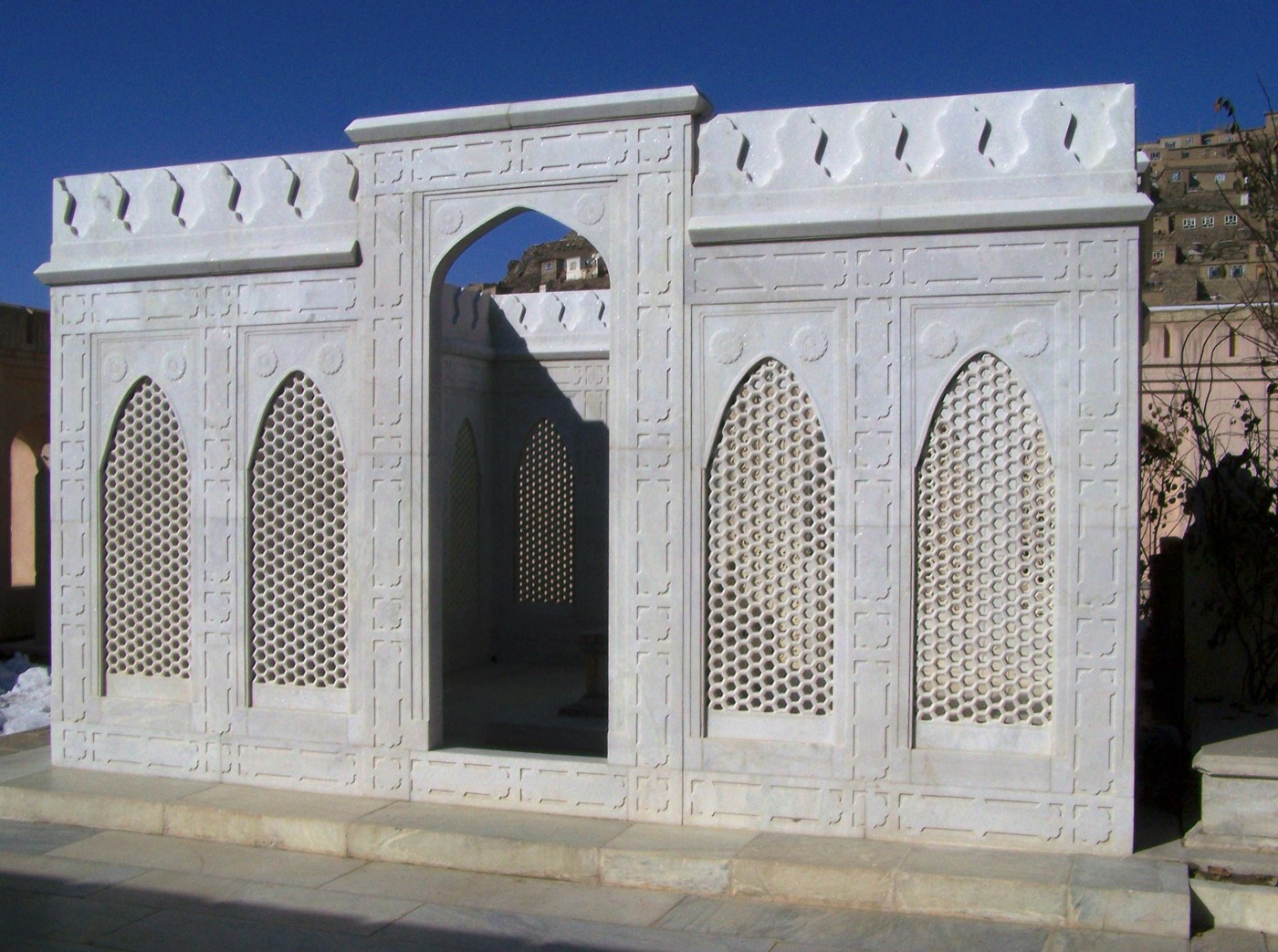
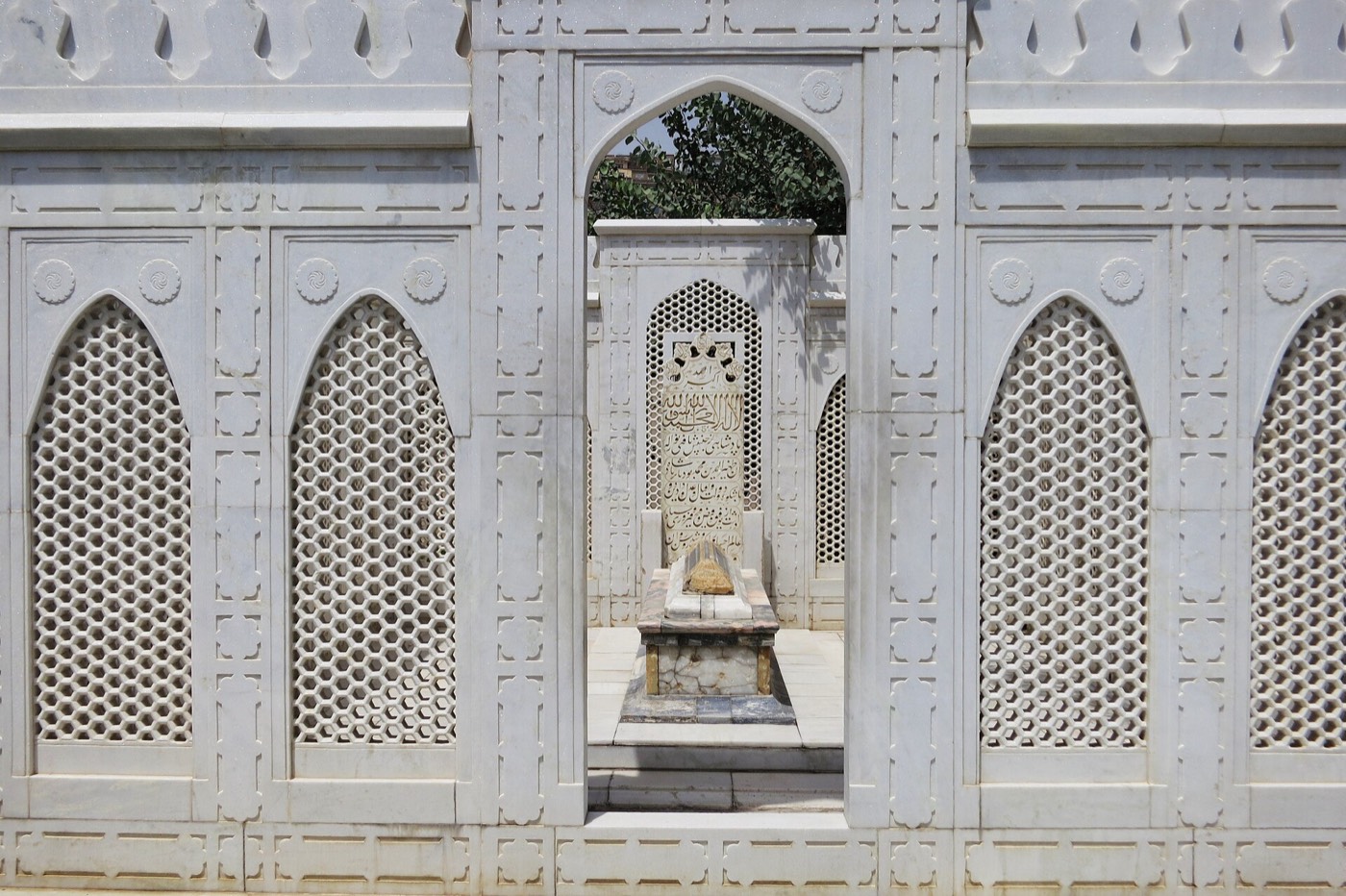
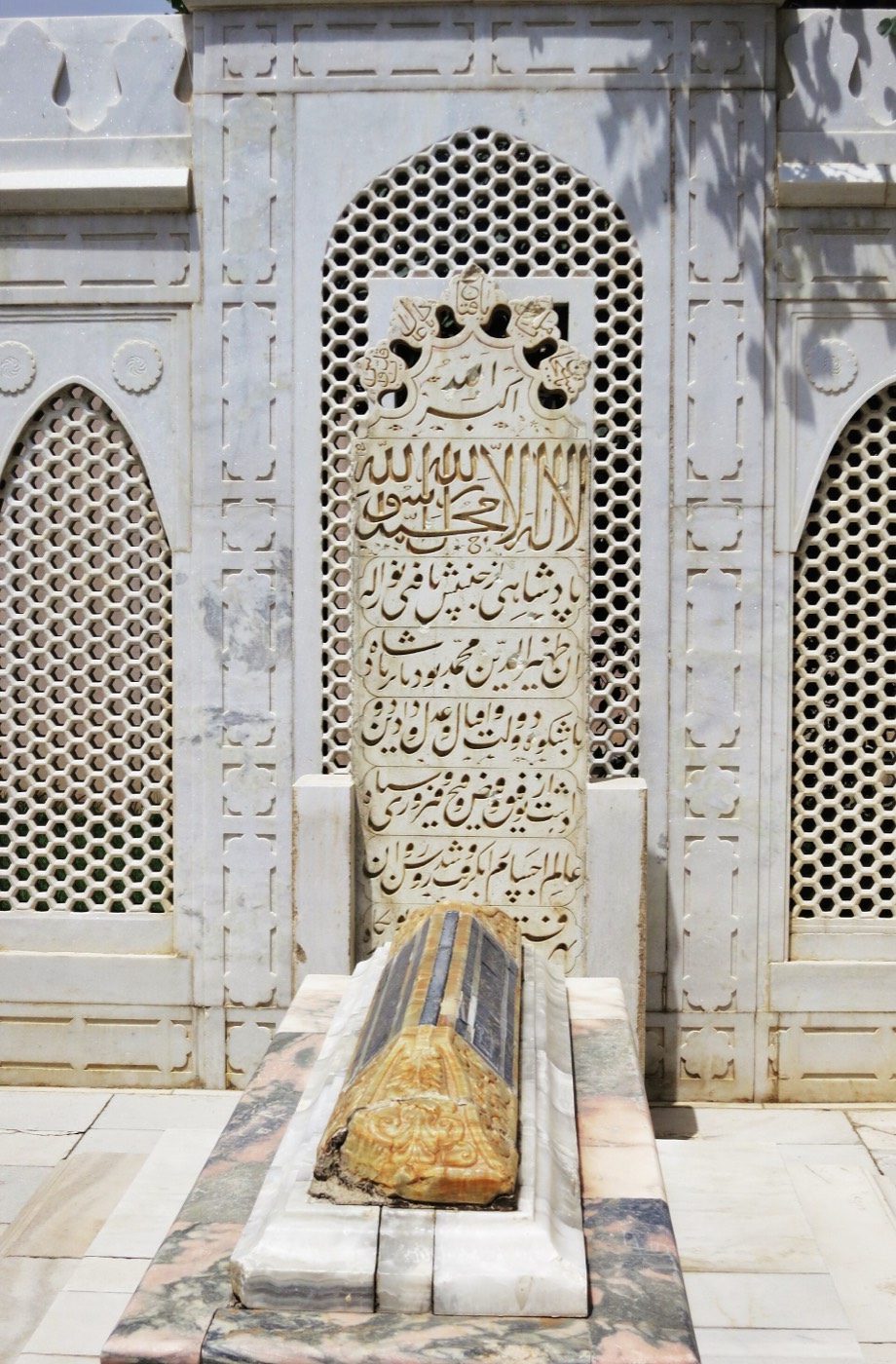
Babur's grave lies on the 14th of the garden's 15 terraces, which cover about 11.5 ha along an east-west axis1,2. The tentative-list entry says Babur wished for a simple earthen grave1. The architecture scholars Munazzah Akhtar, Rabia Ahmed Qureshi and Sarah Javed Shah describe his Mughal tomb as a grave on a plinth inside a low marble screen, with no cover, so that it stayed open to the sky4. Excavations confirmed a marble platform of 17 by 17 m with a lattice (jali) screen, also seen in a photograph of 18791. The tentative list credits Jahangir with the platform and screen, while the AKTC says Shah Jahan put a marble screen round the group of tombs in 16381,2. Writing in the journal Muqarnas, Salome Zajadacz-Hastenrath found no record of work on Babur's tomb under Shah Jahan, whose screen she places round the tomb of Ruqaya Sultana Begum on the 15th terrace, and thinks Babur's enclosure was built at the time of his burial6.
The present marble enclosure was rebuilt from a sketch by the traveller Charles Masson (dated 1838 in the tentative list, 1832 by Zajadacz-Hastenrath) and from marble pieces found in the garden1,6. During the rehabilitation the shelter that Nadir Shah had built over the grave was removed, leaving it open to the sky1,2. The marble mosque of Shah Jahan stands on the terrace below the tomb2. Its dedication calls it a mosque 'fit to stand in so venerable a sanctuary' as the resting place of 'Zahiruddin Muhammad Babur the Conqueror'2. It was dismantled and rebuilt with most of its original marble in the mid-20th century, and conserved again by the AKTC from 2003; the tentative-list entry says its appearance now matches the original1,2. A marble-lined water channel with cascades and fountain basins, rebuilt from excavated evidence, runs down the central axis towards the entrance on the lowest, western terrace1.
What to look for
- Babur's grave, left open to the sky inside its marble screen, as he wished for a simple burial1,4.
- The reconstructed marble enclosure, based on Charles Masson's sketch and on old marble pieces found in the garden1.
- Shah Jahan's marble mosque on the terrace below, with its dedication to Babur2.
- The view down the central axis over the terraces, the water channel and the fountain basins1.
- The foundations of Shah Jahan's gateway, kept in the entrance area on the lowest terrace1.
Visiting
- The garden is a public park; visitors enter at the lowest, western terrace and look up the central axis towards the mosque and the grave1.
- Babur's grave is on the 14th terrace, just above Shah Jahan's mosque2.
- The garden drew 300,000 visitors in 2008, and the AKDN now gives a figure of over 400,000 a year1,3.
Official information: Bagh-e Babur Trust, set up under a 2008 agreement between Kabul Municipality, Afghanistan's Ministry of Information and Culture and the Aga Khan Development Network (AKDN)DirectionsOpen in OpenStreetMapGuided tours in Kabul