History
Avicenna (Ibn Sina) was born at Afshana near Bukhara, in about 980 or, as Dimitri Gutas thinks, some years earlier6,11. From 1015 he lived in Hamadan, treating the Buyid ruler Shams al-Dawla and serving as his vizier until the amir died in 1021; about 1024 he moved to Isfahan to serve the Kakuyid Ala al-Dawla6,11. He died of colic in 1037 on one of Ala al-Dawla’s journeys to Hamadan and was buried there6,11. His grave lay in a large, plain rectangular building in a courtyard visited mostly by dervishes, repaired in 1877 by a Qajar princess, Negar Khanom1. The site had been the house of his friend and host Abu Sa’id Dokhduk, buried beside him1,7.
In 1944 the Society for National Heritage (Anjoman-e Asar-e Melli) was revived to build a new tomb for the millenary of Avicenna’s birth, which fell in 1370 AH (1951)4. Houshang Seyhoun, trained at Tehran University under André Godard and Maxime Siroux, completed his design in Paris in 1949 as his graduation project5. The old building was pulled down and replaced in 1951; Archnet and Talinn Grigor date the new tomb to 1952, and Mohammad Reza Shah inaugurated it on 29 April 19541,2,3. Grigor describes the Society’s pattern in such projects: the remains were exhumed and examined, a modern building rose on the site, and the remains were reburied at a royal inauguration3.
Architecture
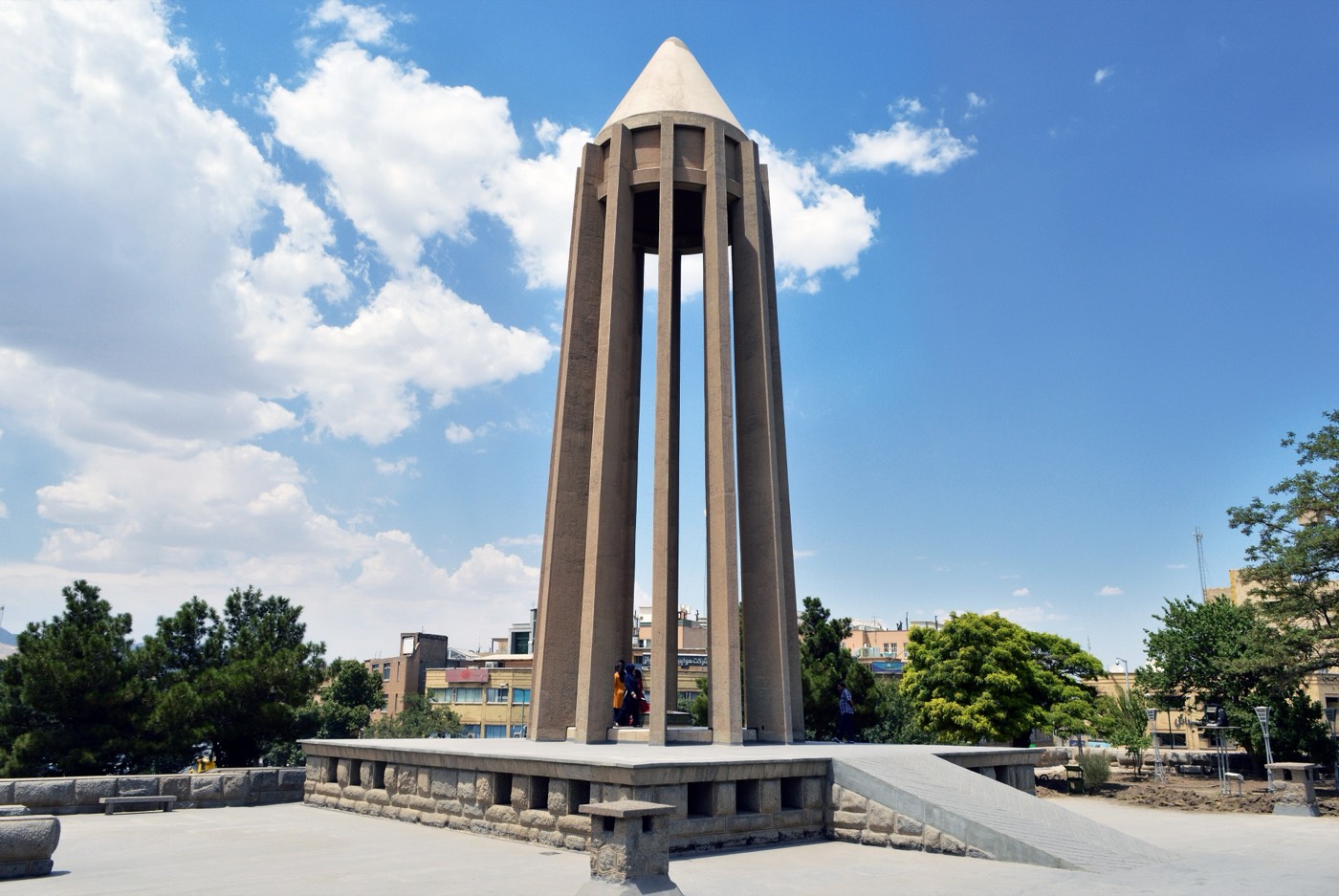
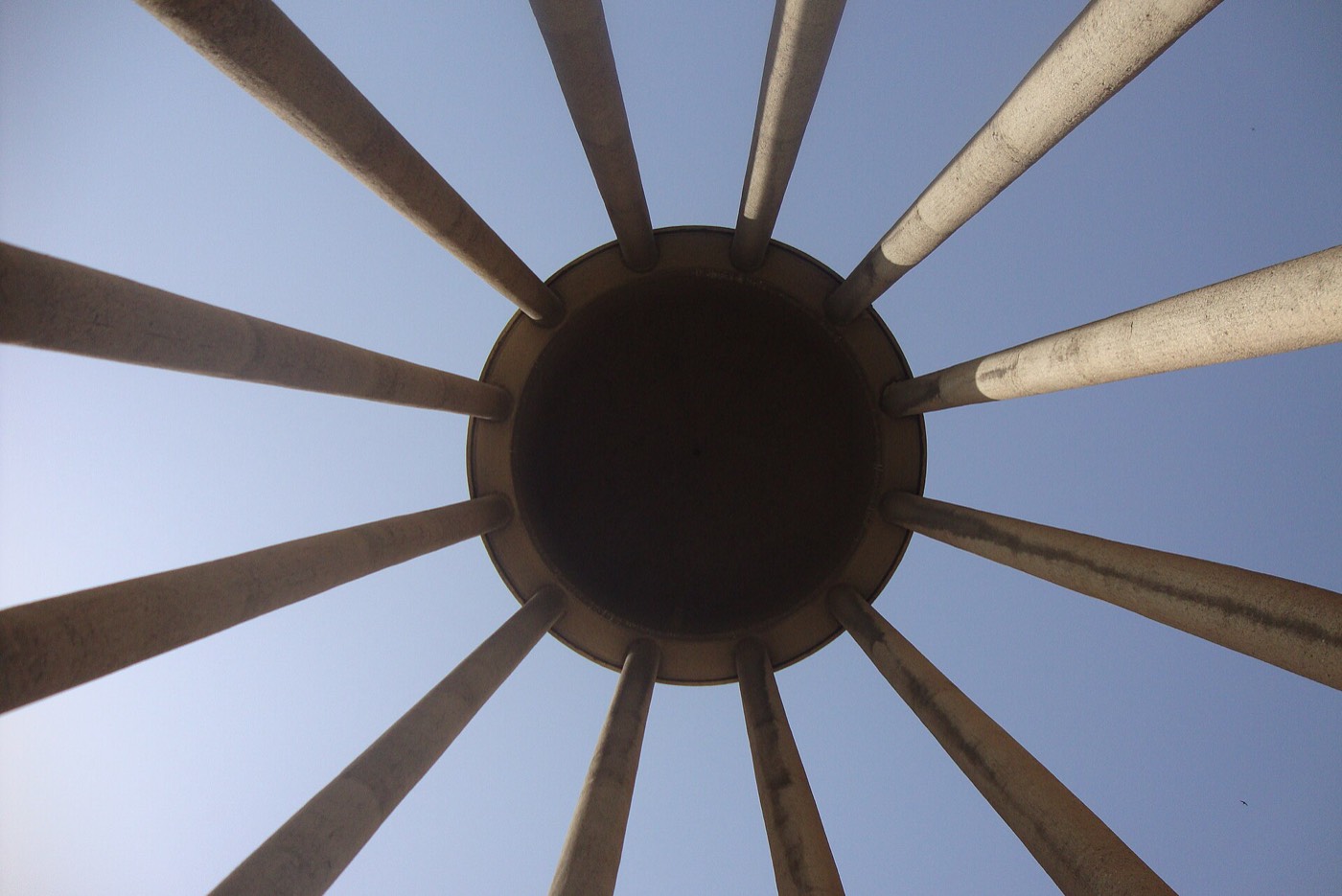
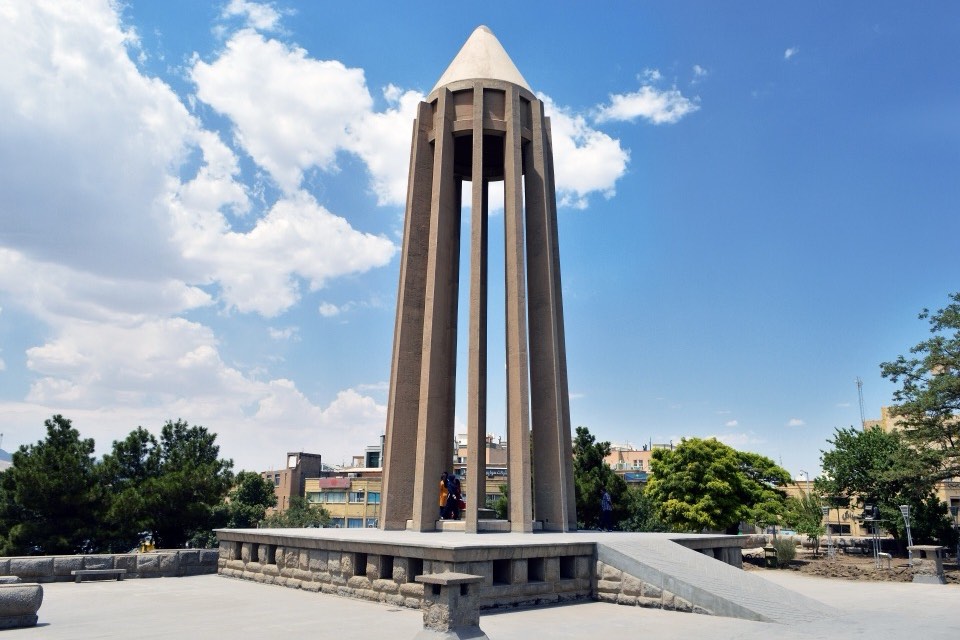
Archnet calls the tower a modern interpretation of Ziyarid tomb towers such as Gonbad-e Qabus, and Mozaffari and Westbrook say the design cites that tower explicitly2,5. Gonbad-e Qabus, already in this atlas, has ten flanges; Seyhoun gave his tower twelve piers instead, which Iran’s official tourism portal links to twelve sciences Avicenna mastered7,8. The piers meet under a conical cap: the building is a little over 28 m high to the tip, the tower rising 23 m above the roof of the tomb7. On the east, the entrance portico has ten round columns of monolithic granite, 4.10 m high, one for each century since Avicenna’s birth7. The Society’s last emblem showed this tower3.
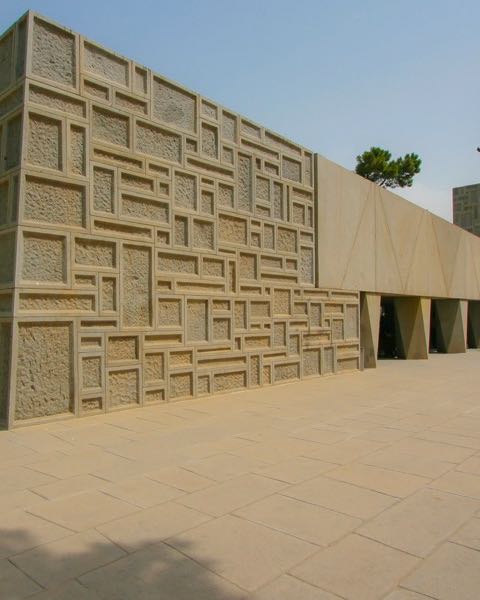
Visit Iran presents the design as a blend of pre-Islamic and Islamic Iranian architecture: gardens on the Persian model, a fountain inspired by the howz-khaneh, the pool room of traditional houses, and a facade of large, rough-hewn granite from Mount Alvand meant to recall ancient palaces7. The complex covers about 3,090 m², of which about 1,792 m² is built, with a museum in the south wing and a library in the north8,9. A white marble statue of Avicenna by Abolhassan Sadighi stands on the east side of the square, and the poet Aref Qazvini is buried in the courtyard1,2,7.
Inside
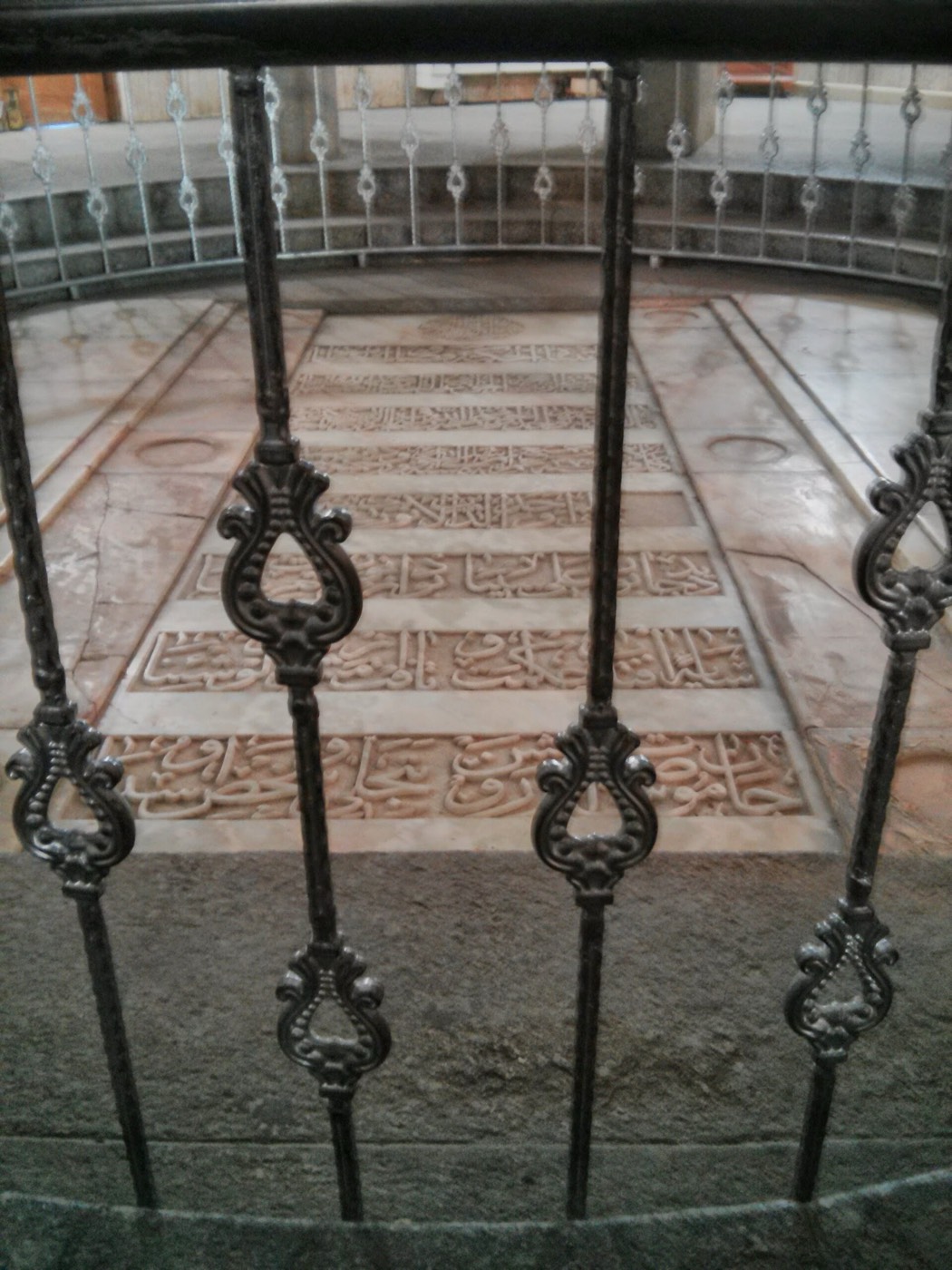
From the eastern portico a wooden door leads into the entrance hall7. On either side lie two gravestones: on the right Avicenna’s old stone, and on the other side that of his host Abu Sa’id Dokhduk7. A single marble slab, inscribed in thuluth script by the calligrapher Ahmad Ma’sumi Zanjani, covers both graves7. Along the upper walls, Avicenna’s philosophical ode known as the ’Ayniyya runs over forty marble panels in thuluth7. Halls to either side hold the library and the museum, where coins, pottery and bronzes found in the region are shown with a photograph of Avicenna’s skull, probably taken when the old building was pulled down7,8,9. On the upper level, at the centre of the tower, stands a square cenotaph with an Arabic inscription in raised thuluth on its four sides7.
What to look for
- The tower’s twelve piers, which Visit Iran links to twelve sciences Avicenna mastered7,8.
- Ten monolithic granite columns at the east portico, one for each century since his birth7.
- The marble slab over the graves of Avicenna and his host, inscribed in thuluth7.
- Avicenna’s ’Ayniyya ode on forty marble panels along the upper walls of the hall7.
- The museum’s photograph of Avicenna’s skull, probably taken when the old tomb was demolished9.
Visiting
- The mausoleum stands in Avicenna (Bu Ali Sina) Square in the centre of Hamadan8,9.
- The museum occupies the south wing and the library the north wing8.
- Hegmataneh hill, the site of ancient Ecbatana, was inscribed on the UNESCO World Heritage List in 2024; the mausoleum is outside the inscribed property10.
Official information: Iran’s Ministry of Cultural Heritage, Tourism and Handicrafts (official Visit Iran portal)DirectionsOpen in OpenStreetMapGuided tours in Hamadan