Этот раздел ещё не переведён, поэтому он показан на английском языке.
История
Şehzade Mehmed, a son of Süleyman I and Hürrem Sultan, was sent to Manisa as provincial governor in 15423,5. He fell ill and died in 950 AH (1543), during the celebrations for the capture of Esztergom, and was buried in Istanbul on the spot where his tomb was to be built3,5. Süleyman, who called him “the choicest of princes”, asked Mimar Sinan for a tomb and gave him a whole complex to build in the prince's name; TDV puts Sinan's age at the time at 544,5. The tomb was the first part of the complex to be finished; according to Şen, a four-line Persian inscription over its door dates it to 15432,5,7.
The mosque, founded on 23 May 1544, opened in August 1548; the complex, on land taken from the old janissary barracks, also had a madrasa, a soup kitchen, a primary school and a caravanserai with stables2. Mehmed's daughter Hümaşah Sultan and his brother Cihangir were later buried beside him5,7. The graveyard filled with other tombs, among them Rüstem Pasha's of 1555 and Damad İbrahim Pasha's of 1603, whose design follows Mehmed's2. Fires in 1613, 1633, 1718 and 1782 damaged the complex, which was thoroughly restored in 1994-19992. Şen reports, from press coverage, that the explosion in Istanbul on 7 June 2016 badly damaged the mosque and the tomb, their stucco windows with coloured glass worst of all; when she examined the tomb again in 2018 she found differences in the double windows of several walls7.
Архитектура
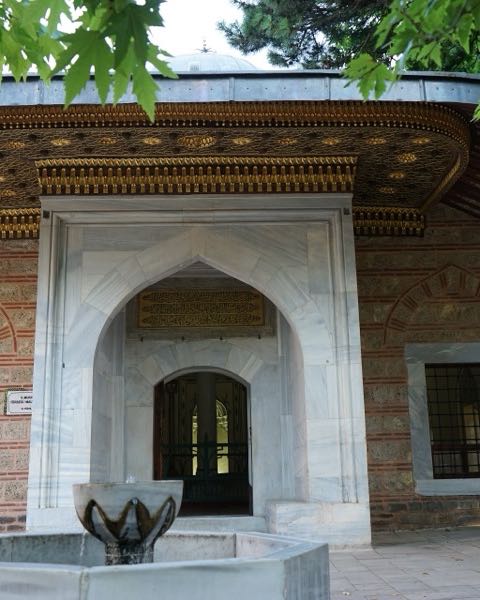
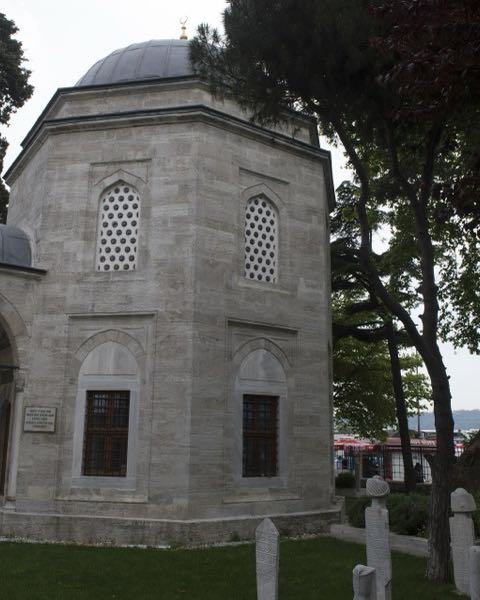
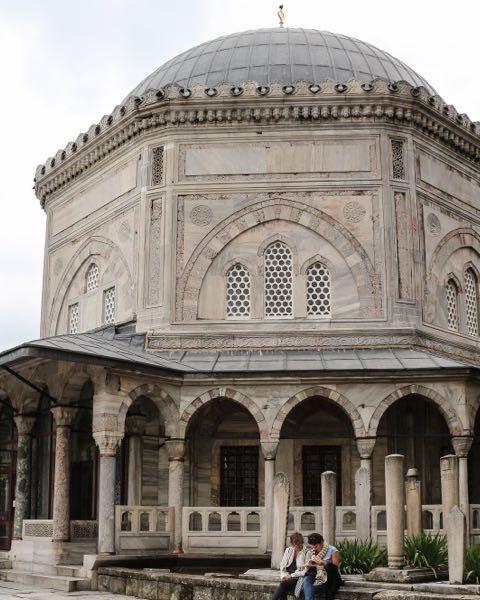
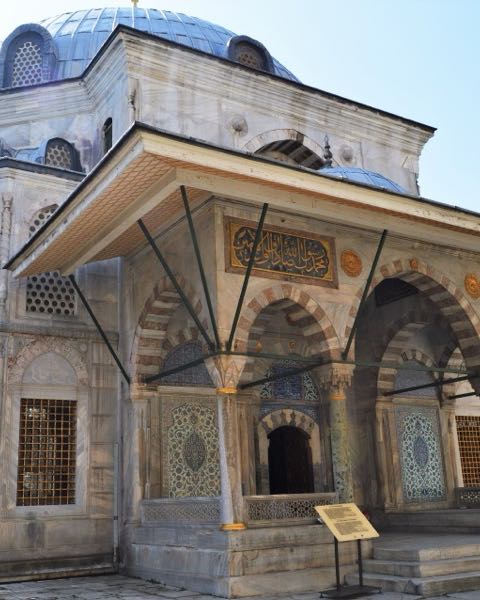
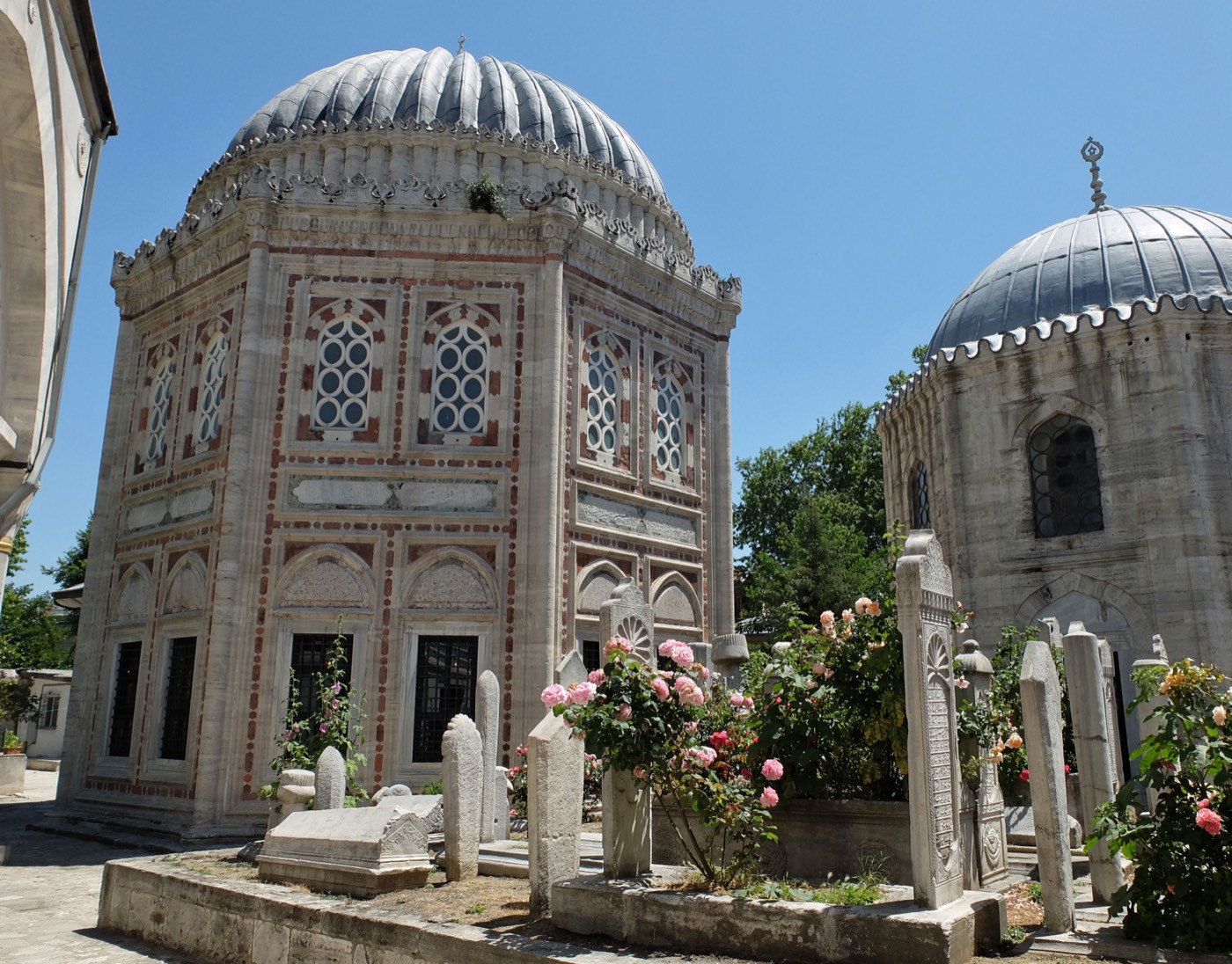
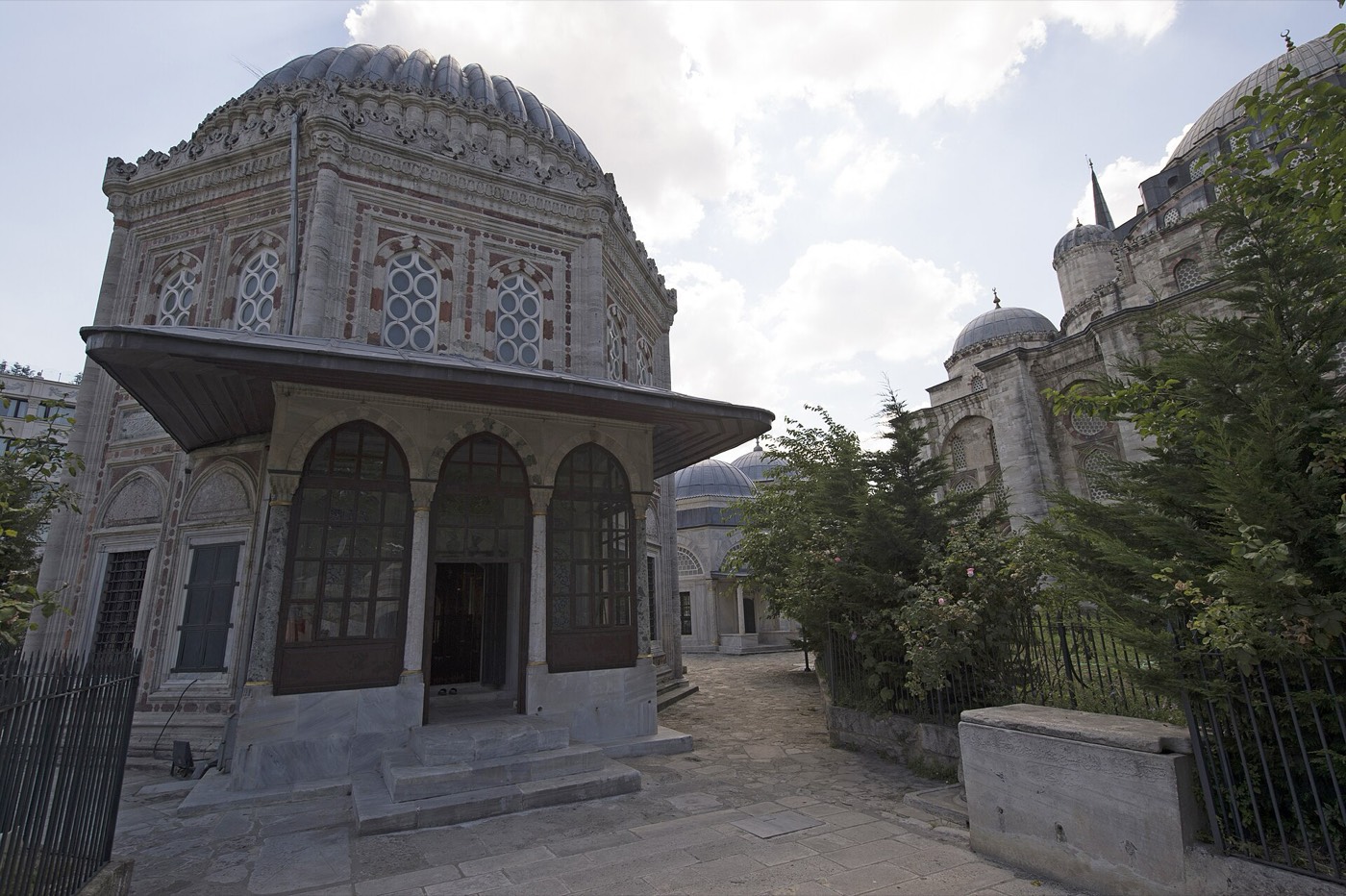
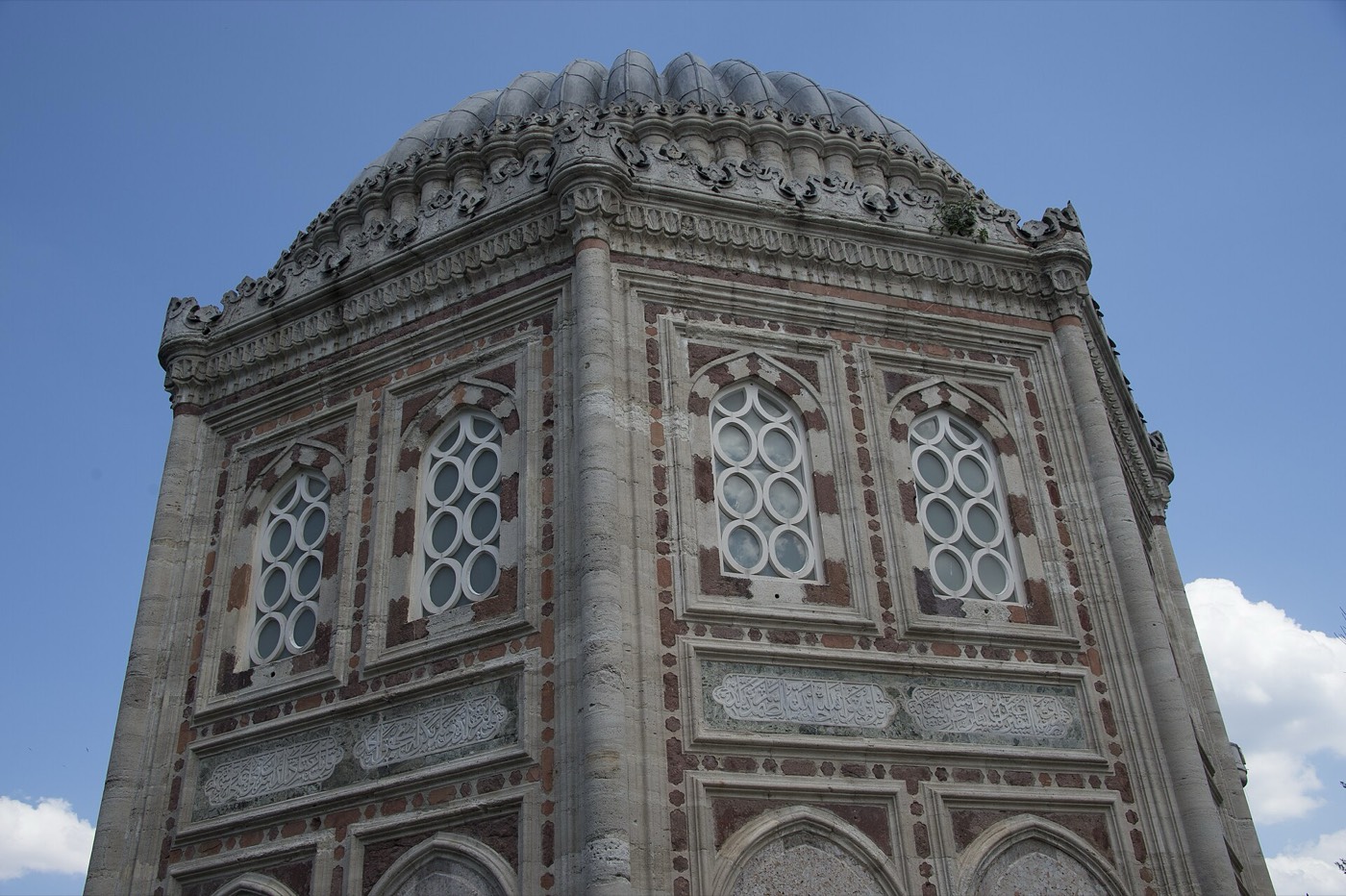
The tomb is an octagon with a fluted drum and dome; TDV links these, and the coloured stonework of the facades, to Iranian and Central Asian influences2,5. Engaged columns divide the eight faces, which have windows in a lower and an upper row, and a three-bay porch shelters the door5,6. Düzenli calls its exterior decoration unusual in Ottoman architecture8. The upper windows are closed by moulded stucco grilles, set with clear glass outside and coloured glass inside, with a gap the depth of the wall between the two layers7. Rüstem Pasha's tomb of 1555, in the same graveyard, repeats these features in a plainer design2. UNESCO names the 16th-century Şehzade Mosque complex among the monuments of the World Heritage property1.
Интерьер
Tiles cover the interior walls entirely2. The ministry describes 16th-century tiles with plant motifs in blue, dark blue, green, yellow and white, which also line both sides of the doorway outside, and an inscription band between the lower and upper windows, inside and out5. The Ashmolean Museum's Iznik timeline lists the mosque and tomb of 1543-44 among the first buildings in the saz style and with the first tulip motifs9. Over Mehmed's cenotaph stands a four-legged, latticed throne (taht) inlaid with ivory; the cenotaphs of Cihangir and Hümaşah Sultan flank his inside a wooden railing, and a fourth, outside it, is unidentified5,7. In the upper windows, coloured glass is set in stucco tracery with palmettes, rumi scrolls, narcissi and hyacinths7.
На что обратить внимание
- The fluted drum and dome, which TDV links to Iranian and Central Asian influences2,5.
- Polychrome stonework and engaged columns on the eight facades2,5.
- The 16th-century tiles that line the whole interior, with yellow among their colours2,5.
- The ivory-inlaid throne (taht) over Şehzade Mehmed's cenotaph5.
- The four-line Persian inscription over the door, dated 15437.
Посещение
- The tomb stands in the walled graveyard south of the Şehzade Mosque at Şehzadebaşı, near the tombs of Rüstem Pasha, Şehzade Mahmud and İbrahim Pasha2,6,7.
- It is one of the tombs assigned to the ministry's Istanbul Tombs Museum Directorate5.
- The neighbouring mosque, finished in 1548, was the first sultan's mosque Sinan built as chief architect; he called it his apprentice work2,4.
Официальная информация: Istanbul Tombs Museum Directorate (İstanbul Türbeler Müze Müdürlüğü), Republic of Türkiye Ministry of Culture and TourismКак добратьсяОткрыть в OpenStreetMapЭкскурсии с гидом: Стамбул